

Solve the problem of rural wind power development: emancipate the mind, adapt measures to local conditions, and implement benefits to the village collective
2024.05.16
Fengmang Energy
"The implementation of the 'Wind Control Action in Thousands of Towns and Villages' is by no means a simple construction of a few wind farms and a few wind turbines in the countryside. Linking it to solving the income problem of village collectives is the main feature that distinguishes the 'Harnessing the Wind Action' project from other projects. The deep integration of wind power with rural revitalization and rural energy revolution is the goal and mission of the 'Wind Harnessing Action'. From April 25th to 26th, Qin Haiyan, Secretary-General of the Wind Energy Professional Committee of the Chinese Renewable Energy Society, emphasized at the 8th Wind Power Development Seminar in the Middle East and South China and the Wind Power Development Forum of "Wind Control Action in Thousands of Towns and Villages".
As a new model for the development and application of wind power, the "Wind Control Action" has attracted much attention from the industry since its introduction. Judging from the survey, the enthusiasm of village collectives to participate in the development and construction of the "Wind Control Action" project is very high.Qin Haiyan called on all parties to break the shackles of concepts, emancipate their minds, and explore a new model of wind power investment for a variety of village-enterprise cooperation and a new mechanism for jointly building and sharing income distribution in the actual operation process.
Qin Haiyan said that the most important principle of this policy is to adapt measures to local conditions. The revenue sharing method, the project grid connection method, the land use method, and the selection of unit technology all need to be adapted to local conditions.The implementation of the "Harnessing the Wind Action" project should not be viewed rigidly, and should not be limited by the previous interim management measures for the development and construction of decentralized wind power projects, and further promote the innovation of systems and mechanisms, so that the green electricity produced by the "Harnessing the Wind Action" project can support rural economic and social construction in a more direct way.
Change the way of thinking and earnestly protect the legitimate income of the village collective
Qin Haiyan said that according to the calculation of wind energy resources in the southern Middle East, one 5-megawatt wind turbine can share dividends of 50,000-100,000 yuan with the village collective every year, and four units (calculated according to the 20 megawatts mentioned in the "Wind Control Action") can reach 200,000-400,000 yuan.
Even in the more affluent Jiangsu and Zhejiang provinces, 200,000 yuan is a "threshold" for the village's collective economic income. Wind power can quickly improve the collective economic income level in China's vast rural areas and form a stable growth source for up to 20 years, which is an important path to revitalize rural land resources, tourism resources, industrial resources and rural collective assets, and let idle resources generate economic benefits.
In the view of Tian Qingjun, senior vice president of Envision Group, the construction of rural wind power is also expected to accelerate the process of rural energy revolution.Taking 20,000 kilowatts of wind power installed in a village (four 5MW wind turbines) as an example, these four wind turbines can generate 40 to 50 million kilowatt-hours of electricity a year.High energy density, small footprint, and high output value - the unique attributes of wind power are expected to effectively explore the integration of wind, solar, storage and charging, and drive more new energy industries to enter rural areas.According to Tian Qingjun's vision, the outbreak of rural wind power in the future can also provide green and cheap electricity to the city and become the center of urban energy supply.
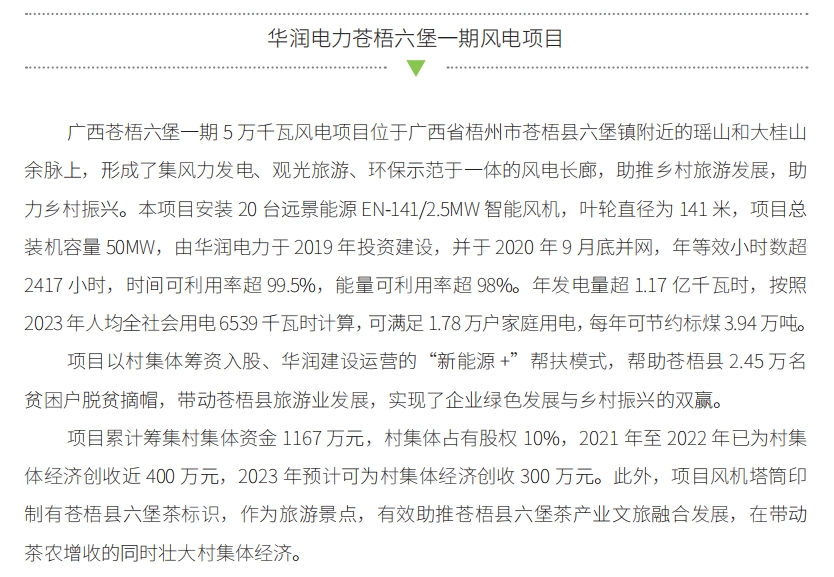
Image source: "Wind Control Action in Thousands of Towns and Villages" wind power project implementation manual
Tian Qingjun told Fengmang Energy that rural wind power must not be equated with traditional wind power in the past. If the traditional concept of developing rural wind power is still followed, non-technical costs such as land, grid consumption, and industrial support will lead to difficulties in the promotion of the project.He predicts that due to the elimination of non-technical costs such as land acquisition, obstruction, and industrial investment, the cost of rural wind power construction will drop significantly, and some areas can recover investment costs in 3-5 years.
As a "new species" under the support of policies, the focus of rural wind power is in the countryside, not on wind power. If this essence is not clarified, then rural wind power is no different from traditional wind power. In order to truly develop rural wind power, it is necessary to find out how to maximize the benefits of the village collective.
At the forum, industry insiders believed that the establishment of rural energy cooperative organizations with clear property rights between enterprises and village collectives in accordance with the law is the key to the "Wind Control Action". All provinces must have correct guidance when formulating specific implementation plans.
According to industry insiders, if the "Wind Control Action" also implements the past model of some counties and cities to attract investment and exchange industries for resources, it will be difficult to mobilize the enthusiasm for investment and development at all levels, and eventually it will be difficult for wind power to go to the countryside to realize the real benefits of village collectives and farmers to benefit. Chen Yongsheng, director of the New and Renewable Energy Department of the National Energy Administration, also stressed at the meeting that the "action" should be based on the premise of fully respecting the wishes of farmers, and explore the formation of a new model of village-enterprise cooperative wind power investment and a new mechanism for jointly building and sharing income distribution.
Emancipate the mind, adapt measures to local conditions, and implement in an orderly manner
In the process of promoting rural wind power, we can continue to use the development and operation experience of traditional wind power and enjoy the fruits of technological progress. According to Tian Qingjun, not counting the non-technical cost, with the blessing of the current technological progress, in some areas such as Jiangsu, the wind speed of more than 6m/s can achieve a cost of about 2 cents of electricity, and the wind speed of 4.5m/s has development value.
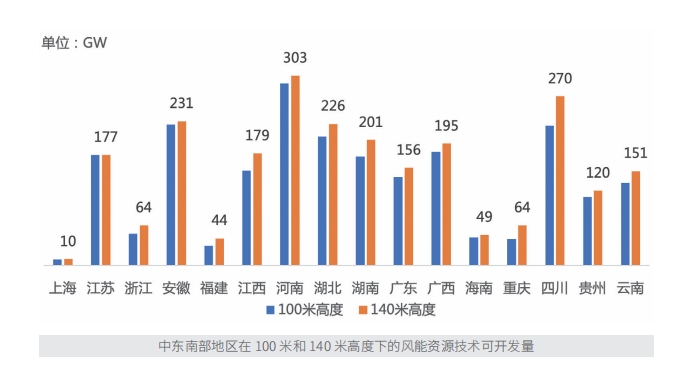
Image source: "Wind Control Action in Thousands of Towns and Villages" wind power project implementation manual
In Qin Haiyan's view, the current "Wind Control Operation" has not yet matured to the stage of full rollout. The "Wind Control Action" was jointly issued by the National Development and Reform Commission, the Ministry of Agriculture and Rural Affairs, and the National Energy Administration, and was endowed with many sustenances and expectations for rural revitalization.In order to avoid chaos in a hurry, the current work focuses more on summarizing experience through pilots and refining replicable models. "Pilot first, when the conditions are ripe, promote one by one, and do not engage in a swarm."
Since the issuance of the "Wind Control Action" policy, Qin Haiyan has repeatedly called for the importance of "adapting measures to local conditions". Taking grid-connected access as an example, the access mode should be flexibly determined according to local conditions. The "Wind Control Action" project can not only determine the grid-connection scheme according to the decentralized management method, but also boost the voltage to access a higher voltage level according to the centralized bundling method.
The development method can also be "adapted to local conditions", and developers are not confined to traditional wind power enterprises. In addition to cooperating with these enterprises to share the benefits of wind power projects through joint ventures or land shares, village collectives can also follow the German model and raise their own funds to invest in construction on their own. Specific links such as EPC, operation and maintenance, etc. can be outsourced to professional enterprises.
All in all, in the process of concrete implementation, all parties should fully emancipate their minds, build when it is appropriate, make full use of the conditions already in place, do not waste resources, and do not miss opportunities.
Based on this, Tian Qingjun put forward four suggestions: break the 110KV on-line voltage level limit; The reform of the electric power system has been further improved, and the sale of electricity through the wall has been fully opened; Simplify the project approval procedures and truly implement the filing system; Rent instead of levy to solve the pain points of land use.
Regarding the safety, noise and other issues that the masses are concerned about, Tian Qingjun suggested that in the process of rural wind power construction, it is not recommended to pursue the latest wind turbines, and to use large-scale promoted units that have been fully verified by the market as much as possible.
Cai Jifeng, president of the Wind Energy Research Institute of Beijing Jianheng Certification Center, mentioned that the unit needs to adopt a low-noise customized design, and the operating noise is recommended to be less than 107 decibels (the current conventional wind farm acceptance standard is 110 decibels, and 3 decibels is equivalent to half the noise energy). The noise impact of the unit on the village shall meet the provisions of GB 3096, and the noise shall not be higher than 55 decibels during the day and 45 decibels at night for the residential area of the village.
Next article:Sany Renewable Energy: Rather do wrong, not miss out, and unswervingly invest in the future
Related testimonials
CCTV Finance × Sany Heavy Industry: Transportation construction continues to heat up! In May, the infrastructure was full of bright spots →
2025.06.17
CCTV Finance × Sany Heavy Industry: Infrastructure results are released! Anhui is soaring, and the equipment of the western port has become a "dark horse"
2025.05.19
China's installed wind and solar capacity has historically surpassed that of thermal power
2025.04.28




0 comments