

Dry! Guidelines and procedures for the development of rural wind power projects
2024.05.20
Polaris Wind Power Grid
The development of wind power in mature villages according to local conditions can not only open up new growth space for wind power development, but also accelerate the transformation of rural energy structure, transform resource advantages into collective income, strengthen the village collective economy, promote the rural energy revolution, and help achieve carbon peak and carbon neutrality.
Basic principles
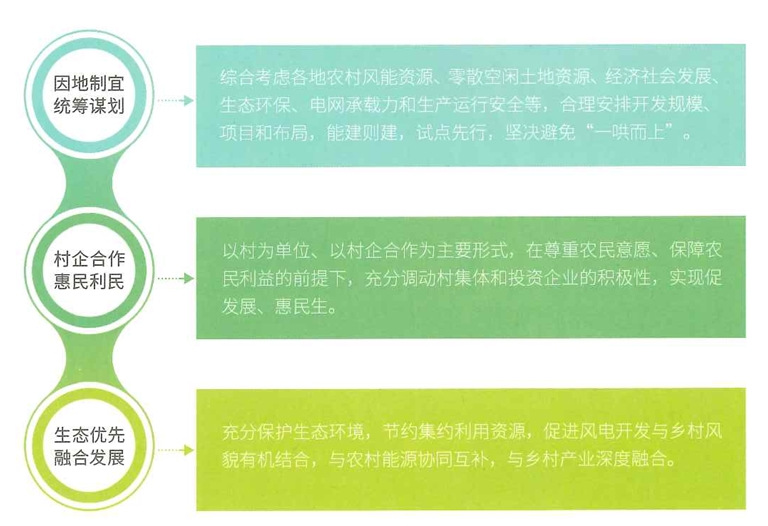
The National Development and Reform Commission, the National Energy Administration, and the Ministry of Agriculture and Rural Affairs jointly issued the Notice on Organizing and Carrying out the "Thousands of Towns and Villages to Harness the Wind Action", which determined the three basic principles of "adapting measures to local conditions, making overall plans", "village-enterprise cooperation, benefiting the people", "ecological priority, and integrated development".
Organization implementation
The "Wind Control Action in Thousands of Towns and Villages" involves provincial-level energy authorities, prefecture-level authorities, county-level authorities, relevant village collectives, power grid enterprises, and investment entitiesWind power equipmentManufacturing enterprises and other relevant parties, through the provincial "Thousands of Towns and Villages Wind Control Action" overall plan, prefecture-level detailed implementation plan, village collectives and investment entities in the "village-enterprise cooperation model co-construction and sharing of several steps, power grid enterprises to cooperate with the overall plan and implementation plan to ensure the safe operation of the project, wind power equipment manufacturing enterprises through technological innovation research and development of wind turbines suitable for the rural environment.

Development process
At present, the development of wind power projects in most provinces adopts the approval method for project approval, and the wind farm development and construction process includes several major stages: preliminary plan formulation, signing of development agreement, obtaining project entry plan indicators, project approval, construction, operation and maintenance. At different stages of the project, it is necessary to obtain the corresponding supporting documents, as shown in the figure below. According to the latest policy of the "Thousands of Towns and Villages Harnessing the Wind Action", the state encourages all localities to explore the trial implementation of the filing system; For projects that do not involve sensitive areas such as soil and water conservation, environmental protection, vegetation restoration, and overlying minerals, the investor and the village collective shall issue a commitment and the relevant competent department shall issue a supporting opinion, and the relevant formalities can be handled in accordance with the law. The introduction of the policy will further simplify the project approval process and improve the efficiency of project development.

Technical Requirements (Recommended)
The development and construction of wind power projects in rural areas, close to residential areas, should focus on the possible impacts on production, life and ecology around the countryside on the basis of meeting the technical requirements of unit selection, site selection, construction, grid connection, operation and maintenance of conventional grid-connected wind power projects, and put forward the following suggestions for the corresponding impact factors:
1. Control the impact of the project on rural production and life
(1) Ensure the safe distance between the unit and the production and living space. The vertical height of the lower blade tip of the unit from the ground shall not be less than 15 meters, and the horizontal distance between the unit and the building shall be greater than or equal to 1.5 times of the sum of the height of the wind turbine wheel and the radius of the wind turbine.
(2) Reduce the noise impact of the unit. Wind turbine operating noise test according to GB/T 22516, the test result should be less than 107dB. The degree of noise impact of the unit on the village shall meet the provisions of GB 3096, and the noise shall not be higher than 55dB during the day and 45dB at night for the residential area of the village.
(3) Control the influence of light and shadow flicker of the unit. It is necessary to calculate and analyze the impact of light and shadow of the unit and provide corresponding calculation reports, and the impact time of the unit layout on the light and shadow sensitive areas (residential areas, schools, hospitals, etc.) should not exceed 30 minutes per day and 30 hours per year.
(4) Equipped with environmental safety facilities. The unit should be equipped with anti-leakage and waste collection devices to prevent the leakage of waste chemicals into the external environment.
2. Improve the technical requirements for project safety
(1) Ensure the safe distance between the wind turbine blades and the tower during operation. The relevant requirements of design and site adaptability in IEC61400-1:2019 should be met, and the elastic safety factor of the blade material should be implemented in accordance with the provisions of clause 1.1 in the standard during the critical deflection analysis of the blade, and the requirements should not be further reduced according to the test situation, so as to retain more safety margin and avoid sweeping to the tower under operating conditions such as strong winds.
(2) Improve the safety protection requirements of rural wind power. Necessary monitoring and protection strategies should be equipped, including but not limited to blade icing identification and protection (for icing sites), vibration monitoring and protection at key locations, monitoring and protection strategies for the distance between blades and towers, etc. The corresponding fire protection system shall be equipped in accordance with GB/T41512-2022.
3. Do a good job in ecological protection and restoration
(1) The project site selection strictly implements the requirements of ecological and environmental protection. Raise awareness of environmental protection, rationally arrange, and avoid areas where construction is prohibited in accordance with relevant environmental protection regulations, such as ecological protection red lines.
(2) Increase investment in ecological environmental protection and restoration. In accordance with the principle of systematization and ecological dominance, a reasonable vegetation and biodiversity restoration plan should be formulated to ensure that the ecological environment is gradually restored to its original level.
(3) Restore temporary land in a timely manner. The area where the temporary land for the construction of the project is farmland will be restored to cultivated land; The area where the temporary land is forest land is restored to forest land; The temporary land is grassland or wasteland, and vegetation restoration is carried out according to the actual situation.
(4) Do a good job in the protection of land resources. Intensive and economical use of land, as little as possible to occupy cultivated land; During the construction excavation, distinguish between the topsoil and the subsoil, retain the topsoil, and restore the topsoil after the construction is used for vegetation restoration or cultivation.
(5) Strengthen ecological and environmental protection supervision. Government authorities have strengthened supervision to ensure that ecological restoration is in place.
Next article:CCTV Finance × Sany Heavy Industry: The operating rate of 21 provinces increased month-on-month
Related testimonials
CCTV Finance × Sany Heavy Industry: Transportation construction continues to heat up! In May, the infrastructure was full of bright spots →
2025.06.17
CCTV Finance × Sany Heavy Industry: Infrastructure results are released! Anhui is soaring, and the equipment of the western port has become a "dark horse"
2025.05.19
China's installed wind and solar capacity has historically surpassed that of thermal power
2025.04.28




0 comments