
Earth-moving machineryConcrete machinerycraneRoad machineryPiling machineryCoal machineryPort machineryWind power equipmentSany heavy truckTrinity ConstructionPetroleum equipmentTrinity EnvironmentEnvironmental engineeringEmergency rescue equipmentMining dump truckstip truckAerial work machineryLithium battery equipmentWarehousing and logisticsPhotovoltaic productsHydrogen equipmentCrushing equipment
Micro-diggingSmall diggingMedium diggingBig diggingWheeled excavatorsLoaderDiversify your productsAttachments
Pump trucksMixer trucksConcrete batching plantOn-board pumpsElectric vehicle on-board pumpsTow pumpMortar pumpsWet sprayerFilling pumpsNew energy mixer truckDry mix mortar mixing plantMortar/concrete dual-purpose batching plant
Truck cranesAll-terrain cranesTruss boom crawler craneTelescopic crawler craneMultifunctional crawler craneFlat-top tower craneTruck-mounted cranes
Reach stackerContainer empty container handlersforkliftGrab steel (material) machinePure electric port tractorTelehandlersShore-to-shore container cranesRail-mounted container gantry craneRubber-tyred container gantry craneGantry crane
3.X Medium and low wind speed wind turbines4.X Medium and high wind speed / all-weather / customized product platform5.X-6. X MW customized product platform
Smart PC equipmentIntelligent AAC equipmentIntelligent steel processing equipmentMobile crushing and screening equipmentMould fixturesCategory 2 standards3 soft 1 platform
Mechanical fracturingElectric fracturingOil-connected equipmentWellhead automationOilfield machineryFracturing pumps
Pure electric road cleaning vehiclePure electric solid waste collection and transfer vehicleMunicipal maintenance vehicles
Compressed air foam fire truckdroneSpecial-duty fire trucksCombat logistics support fire trucksRaise jet fire trucksAscending platform fire truck
High-speed homogenization systemDouble-layer extrusion coaterRoller pressing and slitting machineZ-type cutting and stacking machineWinding machinePrimary and secondary injection machinesCompound capacity needle bedModule PACK line

Earth-moving machineryConcrete machinerycraneRoad machineryPiling machineryCoal machineryPort machineryWind power equipmentSany heavy truckTrinity ConstructionPetroleum equipmentTrinity EnvironmentEnvironmental engineeringEmergency rescue equipmentMining dump truckstip truckAerial work machineryLithium battery equipmentWarehousing and logisticsPhotovoltaic productsHydrogen equipmentCrushing equipment
Micro-diggingSmall diggingMedium diggingBig diggingWheeled excavatorsLoaderDiversify your productsAttachments
Pump trucksMixer trucksConcrete batching plantOn-board pumpsElectric vehicle on-board pumpsTow pumpMortar pumpsWet sprayerFilling pumpsNew energy mixer truckDry mix mortar mixing plantMortar/concrete dual-purpose batching plant
Truck cranesAll-terrain cranesTruss boom crawler craneTelescopic crawler craneMultifunctional crawler craneFlat-top tower craneTruck-mounted cranes
Reach stackerContainer empty container handlersforkliftGrab steel (material) machinePure electric port tractorTelehandlersShore-to-shore container cranesRail-mounted container gantry craneRubber-tyred container gantry craneGantry crane
3.X Medium and low wind speed wind turbines4.X Medium and high wind speed / all-weather / customized product platform5.X-6. X MW customized product platform
Smart PC equipmentIntelligent AAC equipmentIntelligent steel processing equipmentMobile crushing and screening equipmentMould fixturesCategory 2 standards3 soft 1 platform
Mechanical fracturingElectric fracturingOil-connected equipmentWellhead automationOilfield machineryFracturing pumps
Pure electric road cleaning vehiclePure electric solid waste collection and transfer vehicleMunicipal maintenance vehicles
Compressed air foam fire truckdroneSpecial-duty fire trucksCombat logistics support fire trucksRaise jet fire trucksAscending platform fire truck
High-speed homogenization systemDouble-layer extrusion coaterRoller pressing and slitting machineZ-type cutting and stacking machineWinding machinePrimary and secondary injection machinesCompound capacity needle bedModule PACK line
Sany Heavy Industry Sany Heavy Industry Co., Ltd. (SH:600031)
Trinity International Sany International (HK:00631)
Sany Renewable Energy Sany Renewable Energy (SH:688349)
Home > Industry information > The minimum assembly rate is 60%| Beijing's six-part plan for improving high-quality residential construction was released
The minimum assembly rate is 60%| Beijing's six-part plan for improving high-quality residential construction was released
2021.12.07
Trinity Construction
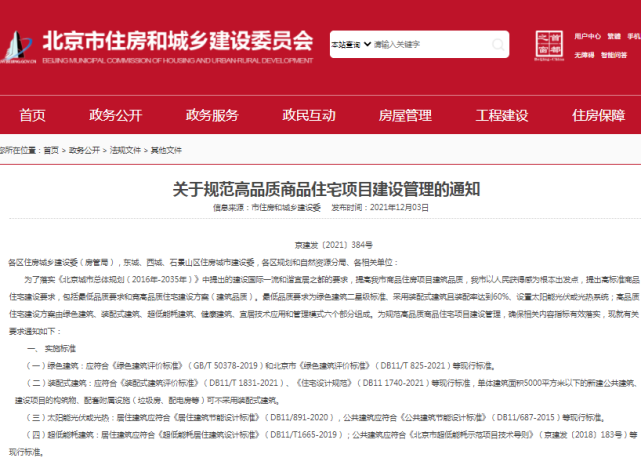
Recently, the Beijing Municipal Commission of Housing and Urban-Rural Development and the Beijing Municipal Commission of Planning and Natural Resources jointly issued the Notice on Regulating the Construction and Management of High-quality Commercial Residential Projects (Jing Jianfa [2021] No. 384). The "Notice" pointed out that in order to implement the requirements of building a world-class harmonious and livable city proposed in the "Beijing Urban Master Plan (2016-2035)" and improve the construction quality of Beijing's commercial housing projects, Beijing has put forward high-standard commercial housing construction requirements based on the people's sense of gain, including: minimum quality requirements and competitive high-quality residential construction plans (building quality). The minimum quality requirements are two-star green building standards, prefabricated buildings with an assembly rate of 60%, and solar photovoltaic or solar thermal systems; The high-quality residential construction scheme consists of six parts: green buildings, prefabricated buildings, ultra-low energy buildings, healthy buildings, livable technology applications and management models.
In order to standardize the construction and management of high-quality commercial residential projects and ensure the effective implementation of relevant content indicators, the "Notice" puts forward clear requirements for implementation standards, process control and organizational guarantees:
1. Implementation standards
(1) Green building: It should comply with the current standards such as the "Green Building Evaluation Standards" (GB/T 50378-2019) and the "Green Building Evaluation Standards" (DB11/T 825-2021) of Beijing.
(2) Prefabricated buildings: should comply with the "Prefabricated Building Evaluation Standards" (DB11/T 1831-2021), "Residential Design Code" (DB11 1740-2021) and other current standards, new public buildings with a single construction area of less than 5,000 square meters, construction project structures, supporting ancillary facilities (garbage room, power distribution room, etc.) can not use prefabricated buildings.
(3) Solar photovoltaic or solar thermal: Residential buildings should comply with the "Energy Conservation Design Standards for Residential Buildings" (DB11/891-2020), and public buildings should comply with the "Energy Conservation Design Standards for Public Buildings" (DB11/687-2015) and other current standards.
(4) Ultra-low energy buildings: Residential buildings should comply with the Design Standards for Ultra-low Energy Residential Buildings (DB11/T1665-2019); Public buildings should comply with current standards such as the Technical Guidelines for Ultra-low Energy Consumption Demonstration Projects in Beijing (Jing Jianfa [2018] No. 183).
(5) Healthy buildings: should comply with the "Healthy Building Evaluation Standards" (T/ASC 02-2016) or the international WELL Building Standards; When a national, industry, or local standard for the implementation of healthy buildings is issued, it should be in line with the current standard.
(6) The livable technical content should be implemented in the design documents such as drawings, among which the application of green building materials should also be implemented in the construction material selection process; The warranty period for the commitment quality of exterior wall insulation engineering, roof insulation engineering, waterproof engineering, and building doors and windows shall be specified in the commercial housing sales contract.
(7) The general contracting mode of the project shall be implemented in the process of project contracting.
(8) The architect responsibility system shall implement the "Guiding Opinions on the Pilot Project of the Beijing Architect Responsibility System" (Jing Gui Zi Fa [2021] No. 28), which gives the architect and the construction unit the right to jointly issue instructions, approve the project, and pay for the visa, and agree on it in the architect's service contract and implement it.
(9) Green building performance insurance should be implemented in the insurance contract.
(10) BIM technology should adopt forward design and comply with the Unified Standard for the Application of Building Information Modeling (GB/T 51212-2016), the Standard for the Design and Delivery of Building Information Modeling (GB/T 51301-2018), the Standard for the Application of Building Information Modeling in Construction (GB/T 51235-2017), the Standard for the Design of Civil Building Information Modeling (DB11/1063-2014), and the Standard for the Fineness of Modeling for the Detailed Design of Civil Building Information Modeling (DB11T1610-2018) and other current standards, and implement the relevant requirements of the "Implementation Opinions on the Application of BIM Technology in the Whole Life Cycle of Engineering Construction Projects".
2. Process control
The management of commercial housing projects is mainly based on the commitment of the construction unit, and all relevant departments strengthen supervision during and after the event.
(1) The project can carry out design bidding after signing the land transfer contract, and the project shall complete the project approval, approval or filing procedures before the general contracting of the project.
(2) Before the construction drawings are recorded, the construction unit shall organize an expert review meeting on the implementation plan, and invite the relevant departments of the Municipal Planning and Natural Resources Commission and the Municipal Housing and Urban-Rural Development Commission to participate in the expert review meeting. The implementation plan for high-quality residential construction shall provide relevant materials such as green building and healthy building self-assessment report, assembly rate calculation book, ultra-low energy consumption building self-evaluation form, and specific measures for the implementation of the architect's responsibility system according to the commitment.
(3) When applying for a construction permit, the construction unit shall fill in the relevant content of green buildings and prefabricated buildings in the construction permit system on the website of the Municipal Housing and Urban-Rural Development Commission.
(4) In the process of construction, the construction unit shall strictly follow the requirements of high-standard commercial residential construction for management, and implement the requirements of green buildings, prefabricated buildings, ultra-low energy consumption buildings, healthy buildings, livable technology applications, architect responsibility systems and other management modes according to the content of the commitment; If the construction drawing design document is changed and the commitment content is affected, the plan review should be reorganized. For projects that promise to apply BIM technology throughout the life cycle, the construction unit shall organize all parties involved in the construction to carry out the application of Building Information Modeling (BIM) in the planning, survey, design, construction, operation and maintenance stages, and shall do a good job in the delivery and application of the model at each stage; The visual model file delivered by the construction unit may also be provided to the property management unit, or the contract stipulates that the construction unit shall deliver the visual model file to the property management unit. Encourage construction units to apply for Beijing Building Information Modeling (BIM) application demonstration projects.
The construction unit shall, as required, fill in the ultra-low energy consumption building information and building materials procurement information in the building energy conservation and building materials management service platform on the website of the Municipal Housing and Urban-Rural Development Commission.
(5) When applying for a pre-sale permit, the construction unit shall submit a pre-sale plan. The pre-sale plan of high-quality residential construction projects shall include relevant information on the management mode such as the self-evaluation report of green building and healthy building, the calculation of assembly rate and the evaluation report of ultra-low energy consumption building, the application of livable technology and the responsibility system of architects, etc., which shall be publicized to the public and supervised by buyers according to the commitment.
(6) After the completion of the project, the construction unit shall carry out special acceptance of green buildings, assembly rates, ultra-low energy consumption buildings, and architect responsibility systems for high-quality residential construction projects in accordance with the promised content, and invite relevant departments of the Municipal Housing and Urban-Rural Development Commission and the Municipal Planning and Natural Resources Commission to participate.
(7) After the completion of the project for the record, the construction unit shall, in accordance with the prescribed procedures, obtain the corresponding grade of green building and healthy building label.
3. Organizational safeguards
(1) Selection of experts:
The construction unit shall conduct expert review of the technical solutions of green buildings, prefabricated buildings, and ultra-low energy consumption buildings in high-quality residential construction projects, and may conduct a comprehensive plan review, and the review experts shall be composed of at least 9 (inclusive) or more (odd number) members. In accordance with the principle of circumvention, the evaluation experts should be randomly selected from the Beijing Green Building Evaluation and Labeling Expert Committee, the Beijing Prefabricated Building Expert Committee, the Beijing Ultra-low Energy Consumption Building Expert Database, the Beijing Engineering Design Industry Advisory Committee, and the Beijing Green Building Materials Expert Committee, and should include architecture, structure, HVAC, construction, interior decoration, parts, BIM, architect responsibility system and other specialties.
(2) Functions of the department:
1. The construction and planning departments at the municipal and district levels shall carry out special inspections on the relevant contents of the management mode of the project such as green buildings, prefabricated buildings, ultra-low energy buildings, healthy buildings, livable technologies and the architect responsibility system.
2. All departments should strictly implement the construction procedures, strengthen supervision and guidance in all aspects of project planning approval, land supply, construction drawing filing, completion acceptance, etc., and do a good job in technical services to ensure that the project is implemented in strict accordance with the requirements of high-standard commercial residential construction.
This notice is applicable to high-quality residential construction projects that have been acquired through centralized land supply within the administrative area of Beijing from 2021 onwards.
Trinity ConstructionWith the mission of "industrializing buildings" and positioning it in "SPCS inside", it empowers the ecology of the five rings of construction (design, manufacturing, construction, development and operation), makes the main structure better, faster and cheaper, and pulls the mechanical and electrical installation, decoration and decoration, and smart home assembly, and finally realizes the building that is not difficult to do in the world.
SPCS has been applied in prefabricated building projects in Beijing, Tianjin, Shanghai, Chongqing, Hunan, Hebei and other provinces and cities. Among them, Sany Intelligent Equipment and Zhuxiang Cloud Platform were successfully selected as the first batch of excellent intelligent construction service cases by the Ministry of Housing and Urban-Rural Development, and the Shanghai Jiading North Juyuan Project using SPCS was successfully selected as the first batch of intelligent construction demonstration projects by the Ministry of Housing and Urban-Rural Development.
The "Sany Cloud Valley" project built by Sany Group in Changsha completely adopts the SPCS system, which comprehensively verifies that the SPCS system makes the building "better, faster and cheaper" from five aspects: safety, quality, construction period, direct cost and cycle comprehensive cost.
SPCS3.0 system is now mature, "cavity lap plus post-casting, shaping mold pouring node, wall, column, beam and plate are fully prefabricated, full assembly above ground and underground, 5231 to empower, better, faster and cheaper", through the practice of millions of square meters of projects, SPCS in green building, resource conservation, environmental friendliness and other aspects of social and economic benefits have been verified.
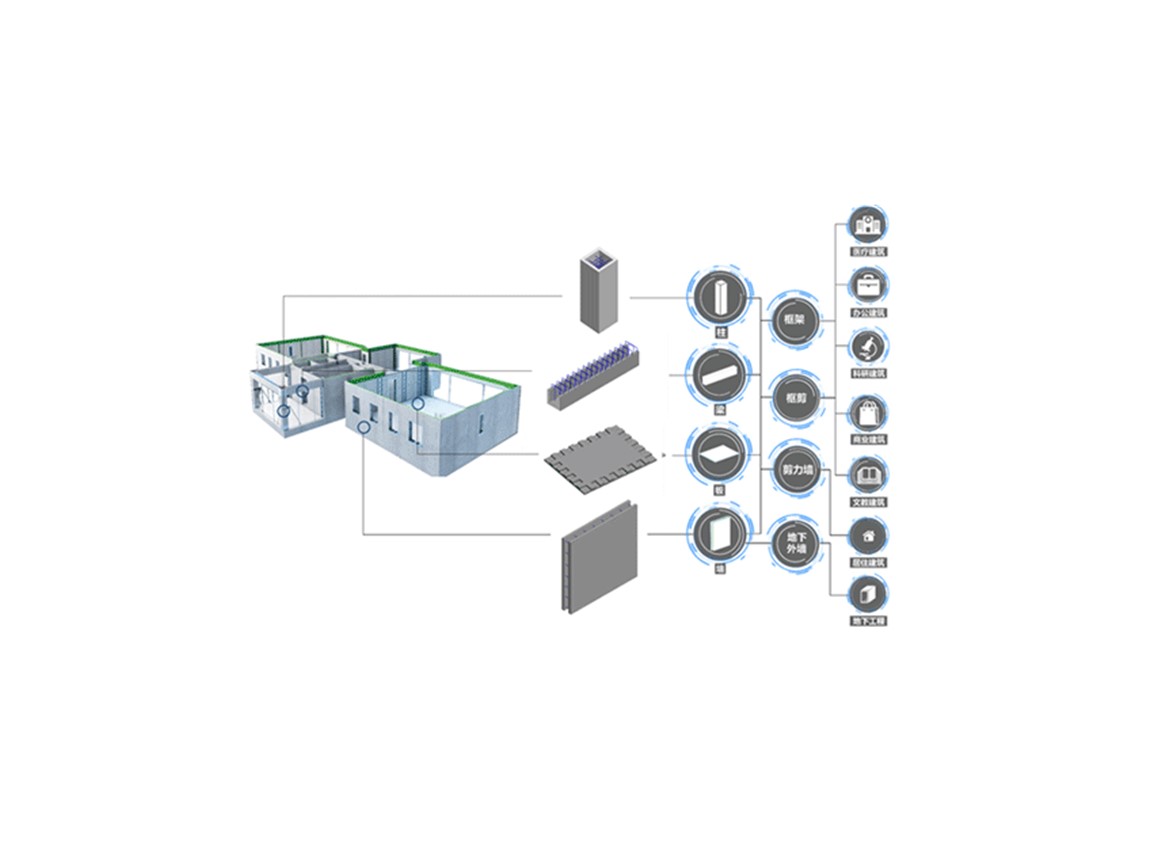
SPCS structural system
Structural standardsRecommended products
Related testimonials
CCTV Finance × Sany Heavy Industry: Transportation construction continues to heat up! In May, the infrastructure was full of bright spots →
2025.06.17
CCTV Finance × Sany Heavy Industry: Infrastructure results are released! Anhui is soaring, and the equipment of the western port has become a "dark horse"
2025.05.19

China's installed wind and solar capacity has historically surpassed that of thermal power
2025.04.28




0 comments