
Earth and stone mechanicsConcrete machinerycranePavement machineryPile MechanicsCoal machineryPort machineryWind power equipmentTrinity heavy truckTrinity BuildersBroken equipmentPetroleum equipmentTrinity EnvironmentEnvironmental protection engineeringEmergency rescue equipmentMining dump truckstip truckAerial work machineryLithium battery equipmentwarehousing and logisticsPhotovoltaic productsHydrogen energy equipment
Micro-diggingSmall diggingMiddle diggingDig bigWheeled excavatorsLoaderDiversified productsAttachment
Pump truckMixer truckConcrete batching plantOn-board pumpsElectric vehicle pumpTractor pumpMortar pumpWet spray machineFilling pumpNew energy mixer truckDry mix mortar mixing plantMortar/concrete dual-purpose mixing plant
truck craneAll-terrain cranesTruss boom crawler craneTelescopic boom crawler craneMultifunctional crawler craneFlathead tower cranetruck-mounted crane
reachstackerContainer empty container forkliftforkliftGrab steel (material) machinePure electric port tractorTelehandle forkliftShore container craneRail mounted container gantry craneTyred container gantry craneGantry crane
3.X Medium and low wind speed wind turbines4.X medium and high wind speed / all-weather / customized product platform5.X-6. X MW customized product platform
Smart PC equipmentSmart AAC equipmentIntelligent steel bar processing equipmentMobile crushing and screening equipmentMold fixtureCategory 2 standards3 soft 1 platform
Mechanical fracturingElectric drive fracturingOil equipmentWellhead automationOilfield machineryFracturing pumps
Pure electric pavement cleaning vehiclePure electric solid waste collection and transfer vehicleMunicipal maintenance vehicles
Compressed air foam fire truckdroneSpecialized fire trucksCombat support fire trucksRaise the high jet fire truckClimbing platform fire truck

Earth and stone mechanicsConcrete machinerycranePavement machineryPile MechanicsCoal machineryPort machineryWind power equipmentTrinity heavy truckTrinity BuildersBroken equipmentPetroleum equipmentTrinity EnvironmentEnvironmental protection engineeringEmergency rescue equipmentMining dump truckstip truckAerial work machineryLithium battery equipmentwarehousing and logisticsPhotovoltaic productsHydrogen energy equipment
Micro-diggingSmall diggingMiddle diggingDig bigWheeled excavatorsLoaderDiversified productsAttachment
Pump truckMixer truckConcrete batching plantOn-board pumpsElectric vehicle pumpTractor pumpMortar pumpWet spray machineFilling pumpNew energy mixer truckDry mix mortar mixing plantMortar/concrete dual-purpose mixing plant
truck craneAll-terrain cranesTruss boom crawler craneTelescopic boom crawler craneMultifunctional crawler craneFlathead tower cranetruck-mounted crane
reachstackerContainer empty container forkliftforkliftGrab steel (material) machinePure electric port tractorTelehandle forkliftShore container craneRail mounted container gantry craneTyred container gantry craneGantry crane
3.X Medium and low wind speed wind turbines4.X medium and high wind speed / all-weather / customized product platform5.X-6. X MW customized product platform
Smart PC equipmentSmart AAC equipmentIntelligent steel bar processing equipmentMobile crushing and screening equipmentMold fixtureCategory 2 standards3 soft 1 platform
Mechanical fracturingElectric drive fracturingOil equipmentWellhead automationOilfield machineryFracturing pumps
Pure electric pavement cleaning vehiclePure electric solid waste collection and transfer vehicleMunicipal maintenance vehicles
Compressed air foam fire truckdroneSpecialized fire trucksCombat support fire trucksRaise the high jet fire truckClimbing platform fire truck
Sany Heavy Industries Sany Heavy Industry (SH:600031)
Trinity International Sany International (HK:00631)
Trinity Renewable Trinity Renewable Energy (SH:688349)
Home > Media coverage > Workers' Daily: The boundary between blue-collar and white-collar workers in Sany's "lighthouse factory" is becoming more and more blurred
Workers' Daily: The boundary between blue-collar and white-collar workers in Sany's "lighthouse factory" is becoming more and more blurred
2021.10.28
Workers' Daily
On October 27, "Workers' Daily" published a series of reports on "How to Transform Employees in Intelligent Manufacturing", "Mix and match, the boundary between blue-collar workers and white-collar workers is becoming more and more blurred", and went deep into Sany Group to feel the changes brought about by the transformation and upgrading of intelligent manufacturing. The report pointed out,In the Sany "Lighthouse Factory", top students and masters are on the same field, engineers and skilled workers are "mixed and matched", and this "new worker" team is accelerating the intelligent transformation of production processes, pushing transformation and innovation to new breadth and depth.
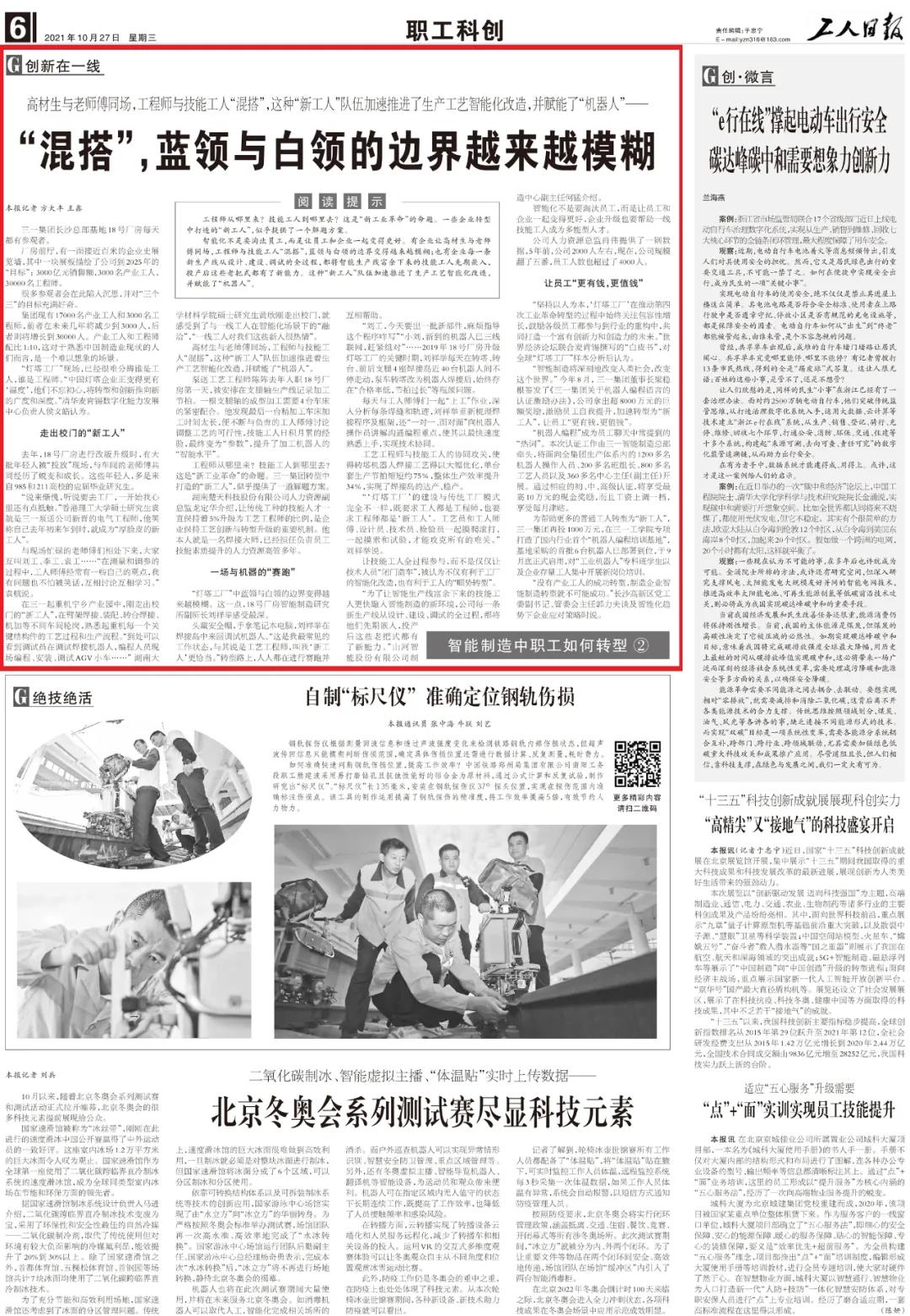
Here's what the report says:
Factory 18 of Sany Group's Changsha Headquarters Base has visitors every day.
In the front hall of the factory, there is a nearly 100-meter corporate history exhibition wall, one of which depicts the company's "goal" by 2025: 300 billion yuan in sales, 3,000 industrial workers, and 30,000 engineers.
Many visitors will be lost in contemplation and curious about the goals of the "Three Threes".
The group currently employs 17,000 industrial workers and 3,000 engineers, the former which will be reduced to 3,000 in the coming years, and the latter will grow to 30,000. The ratio of industrial workers to engineers is 1:10, which is an unimaginable scenario for people familiar with the current situation of China's manufacturing industry.
At the site of the "lighthouse factory", it is already difficult to distinguish who is a worker and who is an engineer. "China's lighthouse companies are becoming more 'warm', and they do not forget their original intentions and push transformation and innovation to new breadth and depth." Hou Wenhao, head of the Tsinghua McKinsey Digital Capability Development Center, believes.
"New workers" who walked out of the school gate
When the No. 18 factory was renovated and upgraded, a large number of young people were "put on" to the scene, and experienced transformation and growth together with the masters in the workshop. Most of these young people are fresh graduates from 985 and 211 universities.
"I'm ashamed to say it, when I heard that I was going to the factory, I was a little resistant at first. Yuan Hang, a master's student at the Hong Kong Polytechnic University and a new electrical engineer at Sany Pumping Company, laughed that he became a "cheeky new worker" when he first arrived last year.
After getting along with the busy masters on the scene, everyone called each other Liu Gong, Li Gong, and Yuan Gong...... "In the process of measurement and adjustment, the workers and masters often have some of their own opinions, and I am not afraid of being laughed at when I have questions, and I discuss and learn from each other." Yuan Hang said.
In TrinitycraneIn Ningxiang Industrial Park, the "new workers" who have just walked out of the school gate are familiar with the process and production process of each key structural part of the crane in different workshops such as boom welding, assembly, turntable welding, and machining. "Debuggers can be seen everywhere debugging welding robots, and programmers programming, installing, and debugging AGV trolleys on the spot......" As soon as Huang Xin, a master's student at the School of Materials of Hunan University, walked out of the school gate, he felt the "harmony" with the front-line workers in the intelligent scene, and "the front-line workers are very enthusiastic about us newcomers".
Top students and masters are on the same field, engineers and skilled workers are "mixed and matched", and this "new worker" team accelerates the intelligent transformation of production processes and empowers "robots".
Pumping process engineer Chen Zhen was arranged to record the processing cycle on the outrigger shaft production line on the first day of joining Plant 18 last year. The forming process of one outrigger shaft requires the close cooperation of four lathes. He found that the processing time of the last finishing lathe was too long, so he constantly discussed with the responsible worker master the feasibility of adjusting the process, and the experience accumulated by the skilled workers over time eventually became a "parameter", improving the "intelligence level" of the processing robot.
Where do engineers come from? Where do skilled workers go? This is the proposition of the "new industrial revolution". The "new workers" created in the transformation of Sany Group seem to provide a solution to the problem.
A "race" against the machine
The boundaries between blue and white collar workers in the "lighthouse factory" are becoming more and more blurred. Liu Xiangju, deputy director of the Intelligent Manufacturing Research Institute of Plant 18, felt this deeply.
Wearing a helmet and a laptop in his hand, Liu Xiangju debugged the robot back and forth in the welding island. "This is my most common working state, and it is more appropriate to call me a 'new worker' than a process engineer." On the road to transformation, everyone is racing and helping each other.
"Liu Gong, today I want to release a batch of new parts, please guide how to write this program" "Xiao Liu, the new robot has been connected to the third line, hurry up and assemble it"...... During the critical period of upgrading the lighthouse factory in Plant 18 in 2019, Liu Xiangju kept walking between nearly 40 robots on the turret, turntable, front and rear outriggers and 4 welding islands every day.
Liu Xiangju reorganized the welding procedures and frames, and explained the key points of communication and programming to the robot operators "one-on-one and face-to-face", so that they could become familiar with it as quickly as possible and achieve technical collaboration.
The collaborative research of process engineers and skilled workers has greatly optimized the welding process of turret robots, shortened the production cycle time of a single set by about 75%, and increased the overall production efficiency by 34%, realizing the production and stable production of the welding island.
"The construction of the 'lighthouse factory' is completely different from the traditional factory model, requiring both workers to be engineers and engineers to be 'new workers'. Technicians and workers, designers, technicians, and inspectors can overcome all difficulties by working together. Liu Xiangju said.
Allowing skilled workers to participate in the whole process, rather than just allowing technicians to "build behind closed doors", is considered to be conducive not only to the intelligent transformation of factories, but also to the "transformation" of workers.
Intelligence is not to eliminate employees, but to make employees and enterprises better together, and enterprise upgrades should also help front-line skilled workers become multi-functional talents.
Make employees "richer and more valuable"
"Adhering to people-oriented, the 'Lighthouse Factory' has always focused on inclusive growth in the process of promoting the transformation of the Fourth Industrial Revolution, and encourages employees at all levels to participate in the restructuring of the industry and jointly create an innovative and creative future." The "White Paper" written by the World Economic Forum and McKinsey analyzes the global "lighthouse factory" sample.
"Intelligent manufacturing will profoundly change human society and the world." In August last year, Liang Wengen, chairman of Sany Group, issued the "Sany Group Certification Incentive Measures for Robot Programming Language", and the company came up with a huge reward of more than 80 million yuan to encourage employees to improve themselves, accelerate the transformation into "new workers", and make employees "richer and more valuable".
"Robot programming" has become a "hot word" often mentioned in employee chats. The certification work is led by Sany Intelligent Manufacturing Headquarters and will be carried out for more than 1,200 robot operators, more than 200 team leaders, more than 800 process personnel and more than 360 center directors (deputy directors) in the group's production system. Those who pass the corresponding junior, intermediate and senior certifications will enjoy cash rewards of up to 100,000 yuan, and their salaries will be raised by one level and they will enjoy monthly allowances.
In order to help more ordinary workers transform into "new workers", Sany Group invested another 10 million yuan to build the first "robot programming training base" in the domestic industry in Sany Institute of Technology, and the first batch of 6 robots purchased by the base has been deployed in place and officially opened at the end of September, focusing on new job training for students of "industrial robot" junior college classes and existing workers of enterprises.
"Without the successful transformation of industrial workers, the intelligent manufacturing transformation of manufacturing enterprises cannot succeed." Guo Lifu, deputy secretary of the Party Working Committee and director of the Management Committee of Changsha High-tech Zone, said when talking about the response strategy of enterprises under the trend of intelligence.
Source: Workers' Daily Workers' Daily reporter Fang Dafeng Wang Xin
0 comments



0 comments