

People's Daily certification: This represents the highest level of intelligent manufacturing and digitalization!
2023.12.06
People's Daily
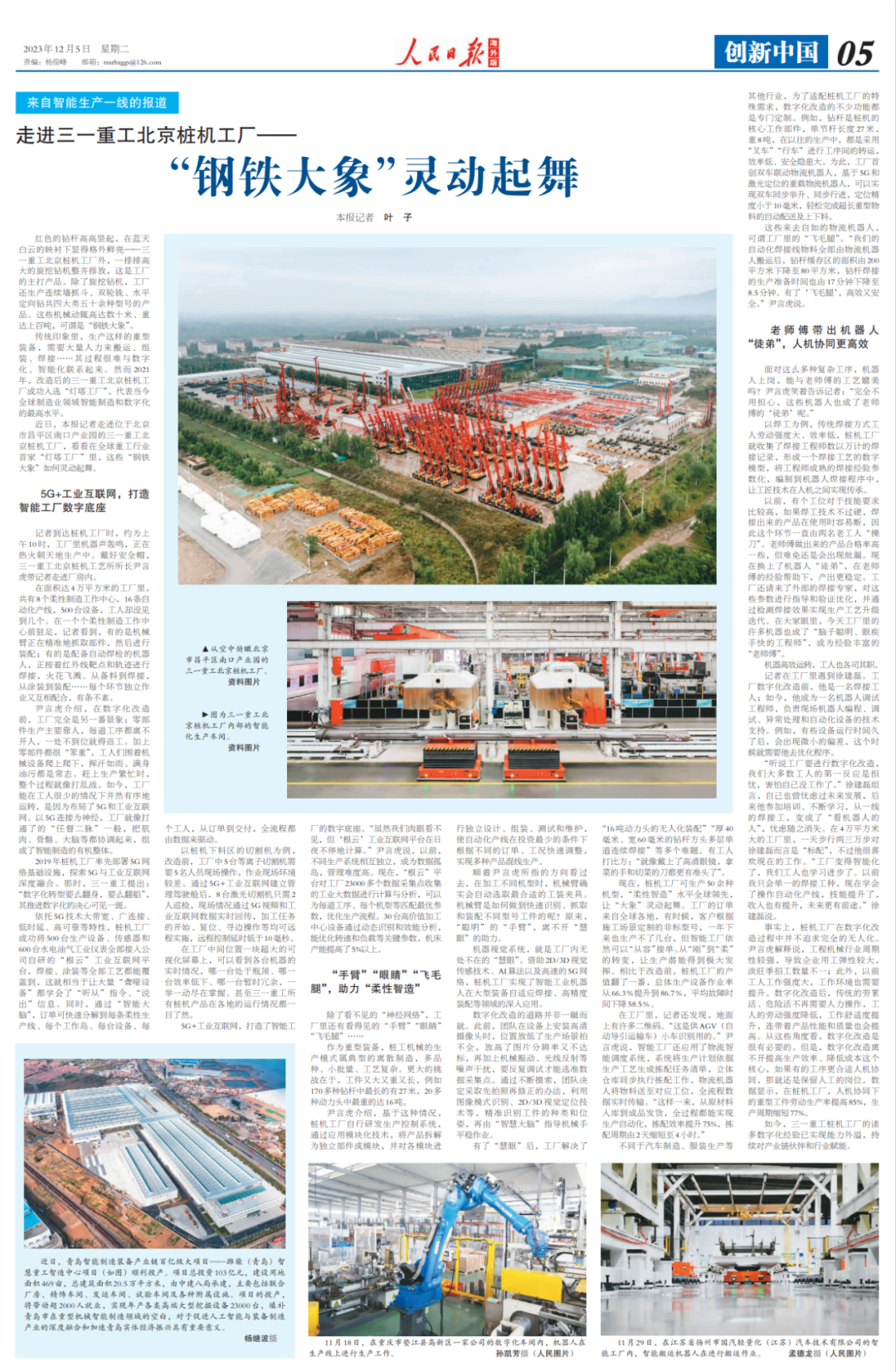
On December 5, "People's Daily" (overseas edition) Innovation China published a full-page article "Walking into Sany Heavy Industry Beijing Pile Driver Factory - "Steel Elephant" Dancing Smartly", exploring the first "lighthouse factory" in the global heavy industry - Sany Heavy Industry Beijing Pile Driver Factory, saying that after its transformation and upgrading, it represents the highest level of intelligent manufacturing and digitalization in the global manufacturing field today.
Original report
The red drill pipe is erected high, and it looks particularly bright against the blue sky and white clouds - outside the Beijing pile driver factory of Sany Heavy Industry, rows of tall rotary drilling rigs are neatly discharged, which is the main product of the factory. In addition to rotary drilling rigs, the factory also produces more than 50 models of products in four categories: diaphragm wall grab, double wheel milling and horizontal directional drilling. These machines can often reach tens of meters high and weigh hundreds of tons, which can be described as "steel elephants".
Traditionally, the production of such heavy equipment requires a lot of manpower to handle, assemble, and weld...... It is difficult to link the process with digitalization and intelligence. However, in 2021, the renovated Sany Heavy Industry Beijing Pile Driver Factory was successfully selected as a "Lighthouse Factory", representing the highest level of intelligent manufacturing and digitalization in the global manufacturing industry today.
Recently, the reporter of this newspaper walked into the Beijing pile driver factory of Sany Heavy Industry located in Nankou Industrial Park, Changping District, Beijing, to see how these "steel elephants" dance flexibly in the first "lighthouse factory" in the world's heavy industry industry.

Overlooking the Beijing Pile Driver Factory of Sany Heavy Industry in Nankou Industrial Park, Changping District, Beijing, from the air
5G + Industrial Internet to create a digital foundation for smart factories
When the reporter arrived at the pile driver factory, it was about 10 o'clock in the morning, and the machines in the factory were roaring, and they were in full swing of production. Wearing a hard hat, Yin Yanhu, director of Beijing Pile Driver Technology Institute of Sany Heavy Industry, took reporters into the factory.
In the factory with an area of 40,000 square meters, there are 8 flexible manufacturing work centers, 16 automated production lines, and 500 pieces of equipment, but the workers have not seen a few. Stopping in front of a flexible manufacturing work center, the reporter saw that some robotic arms were accurately grabbing parts and then assembling them; Some are robots equipped with automatic welding guns, welding according to infrared targets and trajectories, and sparks are flying. From material preparation to welding, from painting to assembly...... Each link works independently and cooperates with each other in an orderly manner.
Yin Yanhu introduced that before the digital transformation, the factory was a completely different scene: the production of parts and components mainly relied on people, and each process was inseparable from people, and one place was not in place and had to be reworked. In addition, the parts are very "bulky", and it is normal for workers to climb up and down around the machinery and equipment, sweating like rain and covered in oil. When it comes to busy production, the whole process is like a scramble. Today, factories are able to operate in an orderly manner with few workers because of the deployment of 5G and the Industrial Internet. With 5G connection as the nerve, the factory is like a "second pulse" that has been opened, coordinating muscles, bones, brains, etc., to form an organic whole of intelligent manufacturing.
In 2019, the pile driver factory took the lead in deploying 5G network infrastructure to explore the deep integration of 5G and industrial Internet. At that time, Sany Heavy Industry proposed: "Digital transformation will either turn over or overturn", which shows its determination to promote digitalization.
Relying on the characteristics of 5G technology, such as large bandwidth, wide connection, low latency, and high reliability, the pile driver factory has successfully connected 500 production equipment, sensors and 600 hydropower, oil and gas industrial instruments to the company's self-developed "Genyun" industrial Internet platform, and all processes such as welding and painting can be covered, which is equivalent to allowing a large number of "deaf and dumb equipment" to learn to "obey" instructions and "speak" information. At the same time, through the "smart brain", orders can be quickly broken down to each flexible production line, each work island, each equipment, and each worker, and the whole process from order to delivery is driven by data.
Taking the cutting machine in the blanking area of the pile driver as an example, before the transformation, the five plasma cutting machines in the factory needed five personnel to operate on site, and the operation site environment was poor. After the management cockpit is established through the 5G + industrial Internet, only 2 people are required to inspect the 8 laser cutting machines, and the on-site situation is transmitted back in real time through 5G video and industrial Internet data, and the start, reset, and edge-finding operation of the processing task can be implemented remotely, and the remote control delay is less than 10 milliseconds.
On a large visual screen in the middle of the factory, you can see the real-time situation of each machine, which one is bottlenecked, which one is inefficient, which one is temporarily redundant, and every move is under control. Even the operation of all pile driver products of Sany Heavy Industry in various places is clear at a glance.
5G + Industrial Internet has created a digital foundation for smart factories. "Although we can't see it with the naked eye, the 'Genyun' industrial Internet platform is computing day and night." Yin Yanhu said that in the past, different production systems were independent of each other and became data islands, which were difficult to manage. Now, the "Root Cloud" platform calculates and analyzes the industrial big data collected by more than 23,000 data collection points in the factory, and can match the optimal parameters for each process and each model, and optimize the production process. The 30 high-value machining centers were able to optimize key parameters such as speed and load through dynamic identification and performance analysis, increasing machine productivity by more than 5%.
"Arms", "Eyes" and "Scuds" help "flexible intelligent manufacturing"
In addition to the invisible "neural network", there are also visible "arms", "eyes" and "scuds" in the factory......
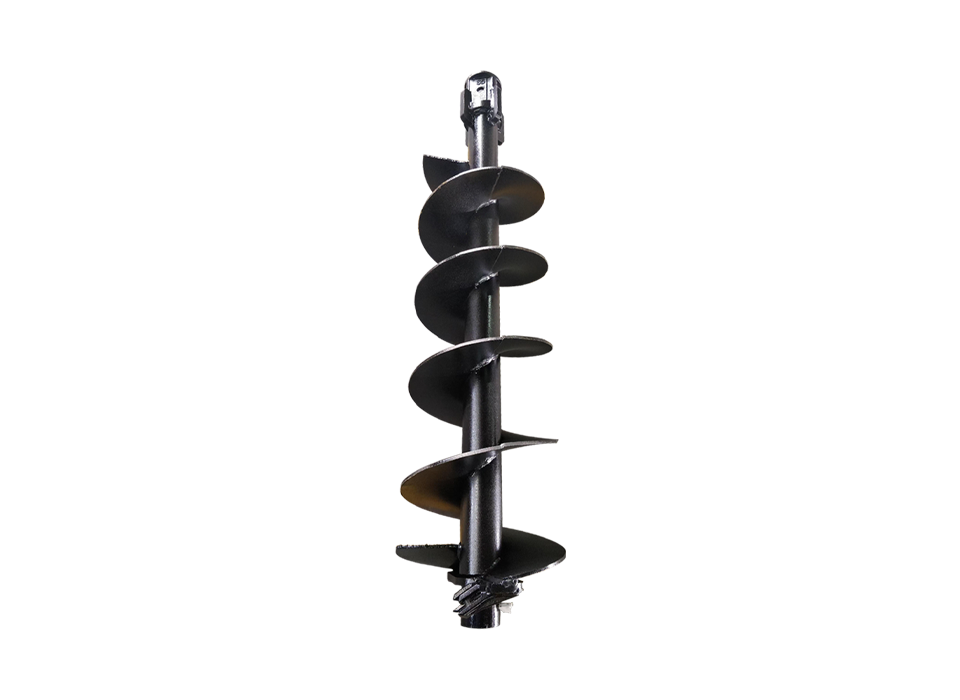
As heavy equipment,Piling machineryThe production mode is a typical discrete manufacturing, with multiple varieties, small batches and complex processes. The bigger challenge is that the workpieces are large, heavy and long, for example, the longest of the more than 170 drill pipes is 27 meters, and the heaviest of the more than 20 power heads is 16 tons.
Yin Yanhu introduced that based on this situation, the pile driver factory developed its own production control system, disassembled the product into independent components or modules through the application of modular technology, and independently designed, assembled, tested and maintained each module, so that the automated production line can be quickly adjusted according to different orders and working conditions under the condition of minimum investment, and realize the mixed production of a variety of products.
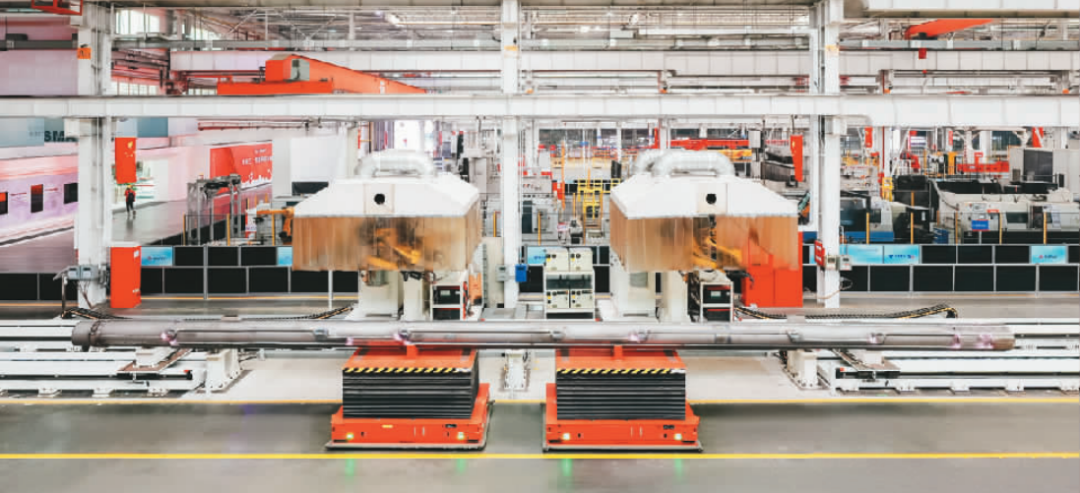
The intelligent production workshop inside the Beijing pile driver factory of Sany Heavy Industry
Looking in the direction pointed by Yin Yanhu, when processing different models, the robotic arm will indeed automatically select the most suitable tooling fixture. How does the robotic arm quickly identify, grip and assemble different types of workpieces? It turns out that the "smart" "arm" is inseparable from the help of the "discerning eye".
The machine vision system is the ubiquitous "insight" in the factory. With the help of 2D/3D visual sensing technology, AI algorithms and high-speed 5G networks, the pile driver factory has realized the in-depth application of intelligent industrial robots in the fields of adaptive welding of large equipment and high-precision assembly.
The road to digital transformation doesn't happen overnight. Previously, when the team installed high-definition cameras on the equipment, the position was lowered to capture the production scene, the image resolution was not up to standard, coupled with noise interference such as mechanical vibration and light reflection, and repeated debugging was required to select the data collection point. Through continuous exploration, the team decided to take pictures first and then correct, using image pattern recognition, 2D/3D visual positioning technology, etc., to accurately identify the type and posture of the workpiece, and then the "smart brain" guided the manipulator to work smoothly.
With "Wisdom", the factory has solved many problems such as "unmanned assembly of 16-ton power head" and "multi-layer single-lane continuous welding of drill pipe square head with a thickness of 40 mm and a width of 60 mm". A worker made an analogy: "It's like wearing high-definition glasses, the hand that holds the vegetables and the knife that cuts the vegetables are more accurate."
Now, the pile driver factory can produce more than 50 kinds of models, and the level of "flexible and intelligent manufacturing" is leading in the world, allowing the "elephant" to dance smartly. Orders from factories come from all over the world, and sometimes, customers can't produce a few non-standard models customized according to the construction scene in a year, but smart factories can still "calmly" receive orders. The transformation from "rigid" to "soft" has greatly exerted the production potential. Compared with before the transformation, the output value of the pile driver factory has doubled, the overall production equipment utilization rate has increased from 66.3% to 86.7%, and the average time to failure has decreased by 58.5%.
In the factory, the reporter also found that there are many QR codes on the ground. "This is for AGV (Automated Guided Vehicle) trolley identification." Yin Yanhu said that the smart factory also applies a logistics intelligent scheduling system, the system will generate a picking task list according to the production plan according to the production process, the three-dimensional warehouse will perform the picking work synchronously, the logistics robot will send the materials to the corresponding station, and the whole process data will be transmitted in real time. "In this way, the whole process from raw material warehousing to finished product delivery can be automated, the picking efficiency is increased by 75%, and the picking cycle is shortened from 2 days to 4 hours."
Different from other industries such as automobile manufacturing and garment production, in order to adapt to the special needs of pile driver factories, many functions of digital transformation are specially customized. For example, the drill pipe is the core working component of the pile driver, with a single rod length of 27 meters and a weight of 8 tons. To this end, the factory pioneered a dual-vehicle linkage logistics robot, a heavy-duty logistics robot based on 5G and laser positioning, which can realize the synchronous lifting and synchronous travel of two vehicles, with a positioning accuracy of less than 10 mm, and easily complete the automatic distribution and loading and unloading of ultra-long and heavy materials.
These logistics robots come and go freely, which can be described as the "scuds" in the factory. "After all the materials in our automated welding line are handled by logistics robots, the area of the drill pipe buffer area has been reduced from 200 square meters to 80 square meters, and the production preparation time for drill pipe welding has also been reduced from 17 minutes to 8.5 minutes. With 'Scud', it's efficient and safe. Yin Yanhu said.
The master brings out the robot "apprentice", and the human-machine collaboration is more efficient
In the face of such a variety of complex processes, can the robot be comparable to the master's craftsmanship? Yin Yanhu told reporters with a smile: "Don't worry at all, these robots have also become the master's 'apprentices'." ”
Taking welders as an example, the traditional welding method workers are labor-intensive and inefficient, so the pile driver factory has collected tens of thousands of welding records of welding engineers to form a digital model of the welding process, parameterize the mature welding experience of engineers, and compile it into the robot welding program, so that the craftsman technology can be inherited between man and machine.
In the past, there was a station with high skill requirements, if the welder's skills were not too hard, the welded products were easy to break when used, so this link has been "operated" by two old workers. The pass rate of the products made by the master is higher, but it is inevitable that there will still be mistakes. Now it has been replaced by a robot "apprentice", and with the help of the master's experience, the output is more stable. The factory also invited external welding experts to guide, verify and optimize these parameters, and realize the production process upgrade and iteration by testing the welding effect. In everyone's eyes, many machines in today's factories have also become "engineers with smart brains and quick eyes", and experienced "masters".
The machines are running efficiently, and the workers are doing their jobs.
The reporter met Xu Jianlei in the factory. Before the digital transformation of the factory, he was a welder; Today, he works as a Robot Commissioning Engineer and is responsible for field robot programming, commissioning, exception handling, and technical support for automation equipment. For example, some equipment will have a small deviation after running for a long time, and then he needs to optimize the program.
"When we heard that the factory was going to be digitally transformed, most of our workers' first reaction was worry, fearing that they would lose their jobs." Xu Jianlei admitted that he had also worried about the future development, and later he participated in training and continued to learn, from a front-line welder to a "robot watcher", and his worries disappeared. In a 40,000-square-meter factory, walking 20,000 or 30,000 steps a day is "standard" for Xu Jianlei, but he likes his current job very much. "The factory has become smarter, and we workers have learned and improved. In the past, I only had a single welding job, but now I have learned to operate an automated production line, my skills have improved, my income has also increased, and my future is more promising. Xu Jianlei said.
In fact, the pile driver factory does not pursue complete unmanned in the process of digital transformation. Yin Yanhu explained that the construction machinery industry is cyclical, resulting in greater flexibility in the employment of enterprises, and the number of workers recruited in the off-peak season is different; In addition, the work intensity of workers in the past is high, and the working environment needs to be improved. After the digital transformation, the traditional tiring and dangerous work no longer requires manual operation, the labor intensity of workers is reduced, the work comfort is improved, and the performance and quality of products will also be improved. From these perspectives, digital transformation is necessary. However, digital transformation is inseparable from the core of improving production efficiency and reducing costs. The data shows that in the pile driver factory, the labor productivity of heavy workpieces under human-machine collaboration is increased by 85%, and the production cycle is shortened by 77%.
Today, many of the digital experience of Sany Heavy Industry Pile Driver Factory has achieved capacity spillover, and continues to empower industry chain partners and the industry.
Content source: People's Daily




0 comments