

Accelerating the construction of a transportation power - sharing of digital transformation and upgrading plans for 8 provinces
2024.10.23
China's road network
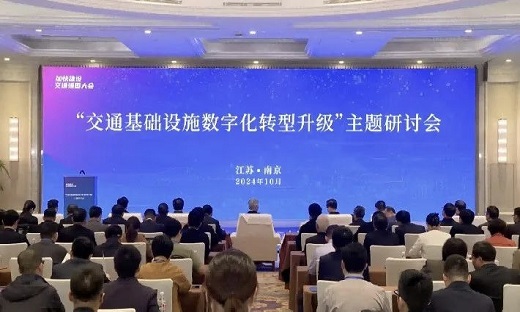
On October 22, the conference on accelerating the construction of a strong transportation country was held in Nanjing, Jiangsu, with representatives from all parts of the national transportation system, as well as specially invited representatives from more than 10 ministries and commissions, including the Central Finance Office and the National Development and Reform Commission, the Ministry of Science and Technology, the Ministry of Industry and Information Technology, the Ministry of Public Security, and the Ministry of Finance. On October 23, at the seminar on "Digital Transformation and Upgrading of Transportation Infrastructure", eight provinces shared the implementation plan for the digital transformation and upgrading of transportation infrastructure in eight provinces.
1. Beijing: "Road-City Integration" Highway Transportation Infrastructure Digital Transformation and Upgrading Demonstration Channel and Network
Focusing on the goal of "alleviating traffic congestion in and out of Beijing, enhancing the capital's traffic support capacity, enhancing the public's sense of travel, and promoting the development of vehicle-road collaborative industry", the six-ring city expressway is used as the contact line, connecting 8 national highways and 6 ordinary national highways, forming a digital intelligent highway network with a total mileage of 971.3 kilometers from the central area of the capital to the Beijing-Tianjin-Hebei region, covering the national comprehensive three-dimensional transportation network "3 axes, 2 corridors and 1 channel", and the Beijing-Tianjin-Hebei "one core and two wings" urban agglomeration.
Adhere to the "integration of data and reality, integration of road and city", and build an overall architecture of "3+1+3+N":
Category 3 infrastructure: highways, ordinary highways and high-level autonomous driving demonstration roads;
1 digital base: convergence and integration of multi-source data such as traffic, traffic management, and autonomous driving;
3 types of users: traffic management departments, transportation infrastructure operation and management units and traffic participants;
N application scenarios: smart sites and service areas, infrastructure health monitoring, "one network" travel services, emergency command and dispatch......
Realize three visions:
Vision 1: People-oriented, "Gaopu City Integration" vehicle-road-cloud collaborative application.
Vision 2: Modernized governance, "road-city integration" traffic operation and control services.
Vision 3: Bottom-line thinking, "integration of peace and emergency" transportation network in the capital.
2. Jiangsu: "One axis, one network, two integrations" demonstration channel and network for the digital transformation and upgrading of high-flow transportation infrastructure
Optimize the top-level design, formulate and issue the "Smart Transportation Development Plan" and "Three-year Action Plan for Digital Transportation Development", and take the lead in releasing technical standards such as smart waterways and smart ports in the country.
Strengthen pilot exploration, and Jiangsu accounts for 3 of the 20 pilot cities for the application of "vehicle-road-cloud integration" in the country; High-quality completion of the "smart transportation key technology research" transportation power pilot task, a number of projects selected as the ministry demonstration project.
Focusing on practical results, the province's expressways have been built into L2 smart highways, and the intelligent upgrade of national and provincial trunk roads has reached 80%; The first provincial-level road network cloud control platform has been built, and its application has been promoted and applied in 18 provinces; In the eastern section of the Shanghai-Nanjing Expressway, the pilot project of smart capacity expansion was innovatively carried out, and the traffic efficiency was increased by 19%; A total of 4,000 kilometers of inland waterway maps and 1,079 kilometers of intelligent perception waterways have been built, ranking first among all provinces and autonomous regions.
Seize the opportunity of being selected as the first batch of demonstration areas for the digital transformation and upgrading of national transportation infrastructure, and implement digital transformation and upgrading of 2,940 kilometers of highways and 1,746 kilometers of waterways in accordance with the overall layout of "one axis, one network and two integrations". Comprehensively accelerate the expansion of smart capacity, effectively strengthen security and efficiency, further promote mechanism innovation, and comprehensively strengthen factor guarantees.
"One axis": the "axis" of digital transformation in the Beijing-Tianjin-Hebei-Yangtze River Delta.
"One network": the "network" of digital transformation in areas along the Yangtze River.
"Two integrations": "two integrations" of highway and waterway transportation.
3. Zhejiang: "One corridor, two wings and whole network" high-quality integrated transportation infrastructure digital transformation and upgrading demonstration channel and network
An overall layout, namely "one corridor": Shanghai-Kunming corridor; "Two wings": Hangzhou as the core, Ningbo in the east, Nanjing in the west; "Whole network": coordinated operation of the whole province.
One core goal, namely "One Alliance": to establish a data operation alliance to jointly build a digital foundation for the brain of the shared transportation industry; "Two improvements": to achieve a 20% increase in trunk line traffic efficiency and a 30% increase in emergency response efficiency, focusing on the implementation of a number of road sections and flight segments of intelligent expansion, safety and efficiency. "Three Highlands": "Three Integrations" travel service highlands for the public; Enterprise-oriented digital operation collaboration highland; Industry-oriented "brain + application" governance highland.
A set of system architecture to achieve active discovery, active control, and active service.
Coordinate the implementation of the "4 aspects and 20 task lists", create 16 characteristic scenarios around smart expansion, safety and efficiency, and industrial integration, refine 66 tasks around system and mechanism innovation, promote key reforms in 4 aspects, and compile more than 20 systems, standards, and norms.
4. Fujian: Cross-strait integrated development of transportation infrastructure digital transformation and upgrading demonstration channel and network
With the theme of "Cross-Strait Integrated Development of Transportation Infrastructure Digital Transformation and Upgrading Demonstration Channels and Networks", the overall layout will be carried out in accordance with "one axis throughout, three-wing interconnection, network-wide coordination, flat and emergency dual-use, and cross-strait integration".
One-axis penetration: through G15, national highway G228, etc., the main axis of the Yangtze River Delta and Guangdong, Hong Kong and Macao is connected;
Three-wing interconnection: through G3, G72 and G76, the "Maritime Silk Road" and "Land Silk Road" are seamlessly connected;
Network-wide coordination: The province will coordinate the construction of smart sites, smart service areas, as well as a travel service network, an operation monitoring network, and an integrated emergency command and dispatch network.
Dual-use of infrastructure in peacetime and emergency: Digitalization of infrastructure is organically integrated in peacetime and emergency use to improve the resilience and versatility of the comprehensive road network.
Cross-Strait Integration: Build a cross-strait digital transportation main channel connecting the inland and Taiwan with Fujian as the hub, and promote the all-round integration of cross-strait transportation, economy and trade, and people-to-people exchanges.
A total mileage of 2,997 kilometers of "5 national high-speeds, 2 provincial high-speed highways, and 4 ordinary national highways" such as Shenhai Expressway and Beijing-Taiwan Expressway was selected as demonstration channels to carry out digital transformation construction. Accurately implement the "5+10" special task, and make every effort to achieve the overall goal of "one platform, two intelligent networks, three unimpeded travel, four early warnings, and five modes".
5. Henan: "One axis and one corridor" demonstration channel and network for digital transformation and upgrading of transportation infrastructure
By 2027, the "three improvements" will be achieved - the traffic efficiency of the demonstration channel will be significantly improved, the emergency response efficiency will be significantly improved, and the satisfaction with travel information services will be significantly improved.
The first is to re-integrate - to improve the level of innovative application of comprehensive transportation big data.
The second is to focus on efficiency - to improve the ability to ensure the smooth flow of the road network under large traffic. Establish a three-layer intelligent management and control system of sites, road sections, and road networks.
The third is to focus on innovation - deepen policy research and guide the public to travel reasonably. Implement differentiated toll collection policies for highways by volume, time period and classification.
6. Hunan: "One circle, two axes and three districts" Chang'an Shumei transportation infrastructure digital transformation and upgrading demonstration channel and network
Coordinate new construction, reconstruction and expansion projects; Inter-provincial linkage, prefecture-city linkage, and trunk and branch linkage.
Efficient operation and cost-effective: "One Circle" large hub ("3+5" urban circle): The traffic efficiency of important road network trunk nodes has been significantly increased by 20%.
Travel safety and system resilience: "two-axis" corridors (Beijing-Hong Kong-Macao main axis, Shanghai-Kunming corridor): The emergency response efficiency of highway and waterway emergencies has been effectively increased by 30%, and the reach rate of severe weather services has ≥ 95%.
Convenient access and inclusive services: The "three zones" network (Guangdong, Hong Kong, Macao, Yangtze River Delta, and Chengdu-Chongqing regions): cross-provincial travel service information is homogeneous, and the public service satisfaction ≥ 95%.
Integration and innovation, multiple collaboration: Establish a multi-cross collaboration mechanism, establish a data operation mechanism, build a co-construction and sharing digital foundation, and improve the standard and specification system.
A new pattern of digital transportation development focusing on industry governance and transportation services has been formed, and the digitalization, networking, and intelligence of the industry have been significantly improved, which strongly supports the high-quality development of the industry and the construction of a transportation power.
7. Guangdong: "One axis, two networks" transportation infrastructure digital transformation and upgrading demonstration channel and network
Anchoring the overall goal of "walking in the forefront", adhere to the overall promotion and innovation-driven, efficiently promote the large-scale implementation of innovative application scenarios in the demonstration area, effectively improve the public service capacity, industry management energy efficiency and industrial collaborative innovation level, contribute to the digital transformation and upgrading of the national transportation infrastructure, and be a good pioneer for the Guangdong-Hong Kong-Macao Greater Bay Area to create a "strategic fulcrum of the new development pattern, a demonstration place for high-quality development, and a leading place for Chinese-style modernization".
Traffic efficiency: The traffic time of bicycles at toll stations that implement ramp pre-trading will be reduced by 10%; The average driving speed during peak hours of the road sections that implement the smart expansion of trunk lines will be increased by 20%; The average waiting time for locks has dropped by 20%.
Safety and efficiency: The emergency response efficiency of highway and waterway emergencies has been increased by 30%; The rate of vehicle violations exceeding the limit decreased by 10%.
Travel services: The satisfaction rate of road travel services and ship lock crossing services exceeds 90%.
Data operation: Completed the development of 10 security early warning data products and completed 5 scenario data transactions.
Focus on ten scenarios: smart expansion of the trunk line network in the Guangdong-Hong Kong-Macao Greater Bay Area, "Guangdong Pass" travel service brand, infrastructure monitoring and early warning and severe weather monitoring, air-ground integrated monitoring network, smart lock joint scheduling and monitoring and early warning, electronic port chart, emergency command and dispatch, vehicle-road-cloud industry data space, industry high-precision digital base, and data operation mechanism.
8. Sichuan: "Dashu Road" transportation infrastructure digital transformation and upgrading demonstration channel and network
Overall goal: 90% of the busy sections of national high schools and 25% of the busy sections of ordinary national highways will complete the digital transformation and upgrading, forming a development pattern of "one network monitoring, one-click linkage, and integrated management".
3. Coverage (perception facilities): major bridges and tunnels of expressways, slopes and disaster-prone points, important nodes of ordinary highways;
3. Improvement (efficiency service): 20% increase in traffic efficiency during peak hours on busy road sections; The efficiency of emergency response to emergencies has been increased by 30%; The travel service experience has been significantly improved.
Smart capacity expansion involves smart sites, active management and control of trunk channels, "one network" travel services, and smart service areas.
Safety and efficiency enhancement involves the construction of smart tunnels, infrastructure monitoring and early warning, severe weather traffic warning, road network operation monitoring and early warning, emergency command and intelligent scheduling, digital overcrowding and large-scale transportation of the whole chain supervision.






0 comments