

Breakthroughs have been made in the challenges of customization and high precision, and new progress has been made in the intelligent production of high-end equipment
2025.03.24
People's Daily
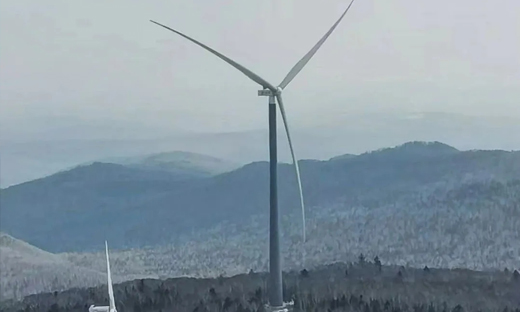
With a gentle breeze, the standing wind turbines rotate leisurely, sending a steady stream of green electricity. How is such a behemoth made?
Many people may not think that the production of blades, the key component of wind turbines, has long been a labor-intensive industry, and due to its large volume, heavy weight and complex surface surface, it often relies on a large number of manual processes such as laying, pouring, grinding and painting.
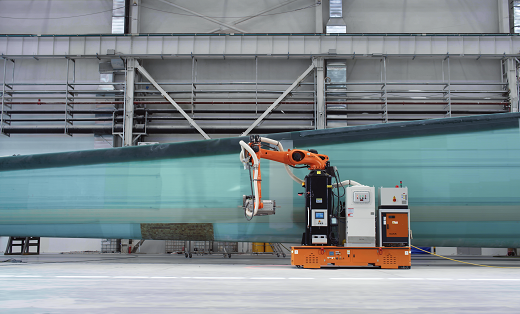
Nowadays, walking into Sany Renewable Energy's Shaoshan Blade Factory, the fully intelligent auxiliary positioning technology helps shape the main beam of the blade and form the "backbone" of the blade; Large-scale centralized perfusion technology realizes the automation of the whole process of resin material intake, storage and use, and builds the "muscle" of the blade; The robot cooperates with laser guidance technology to automatically complete the surface grinding and painting of the blade to improve the "skin" of the blade...... In just one day, an 82-meter-long blade can be rolled off the production line in the smart workshop."Such efficiency is due to the perfect combination of intelligent brain and intelligent equipment, which realizes automated production by improving the process flow." Peng Haibing, head of Sany Renewable Energy's Shaoshan Blade Factory, said that as long as a tablet computer, it can monitor the temperature and humidity of the workshop, the blade grinding smoothness coefficient and other indicators in real time, and realize the lean management of the whole process.
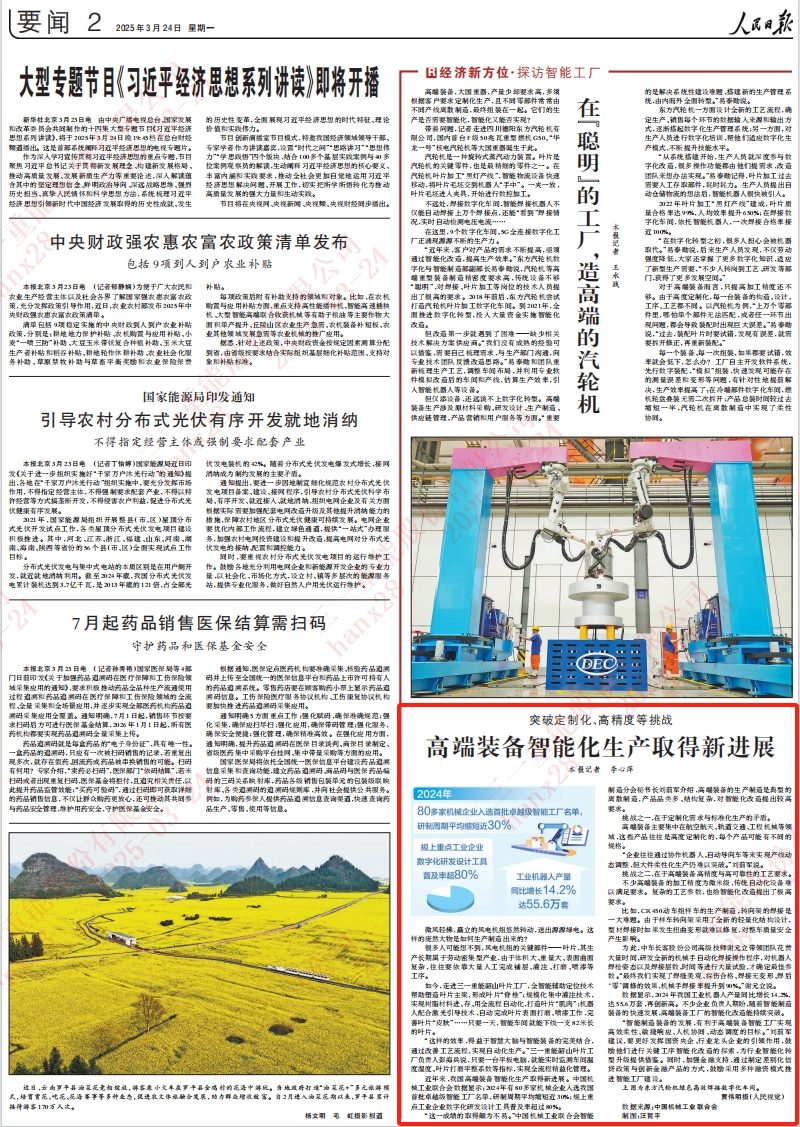
In recent years, new progress has been made in the intelligent production of high-end equipment in China. According to data from the China Machinery Industry Federation, more than 80 machinery companies will be selected into the list of the first batch of excellent smart factories in China in 2024, and the development cycle will be shortened by nearly 30% on average; The penetration rate of digital R&D and design tools in key industrial enterprises above the designated size exceeds 80%.
"This achievement is not easy to achieve." Liu Qianjun, Secretary-General of the Intelligent Manufacturing Branch of the China Machinery Industry Federation, introduced that the production and manufacturing of high-end equipment is a typical discrete manufacturing, with many product categories and complex structures, which puts forward higher requirements for intelligent transformation.
One of the challenges lies in the contradiction between customized needs and standardized production.High-end equipment is mainly concentrated in aerospace, rail transit, construction machinery and other fields, these products are often highly customized, and each product may have different specifications."Enterprises often use collaborative robots, automatic guided vehicles, etc. to achieve dynamic adjustment of production lines, but it is still difficult to break through the flexible production of large items." Liu Qianjun said.
The second challenge lies in the process requirements of high-precision and high reliability of high-end equipment.The processing accuracy of many high-end equipment is micron-level, and it is difficult for traditional automation equipment to meet the requirements. Complex process parameters also put forward extremely high requirements for intelligent transformation.
Data show that in 2024, the output of industrial robots in China will increase by 14.2% year-on-year to 556,000 sets, a new high. Many enterprise leaders expect that with the rapid development of intelligent manufacturing equipment, the intelligent transformation of high-end equipment factories can continue to make breakthroughs."The development of intelligent manufacturing equipment is conducive to the realization of the goals of efficient and flexible, agile response, human-machine collaboration and dynamic scheduling of high-end equipment intelligent factories." Liu Qianjun suggested that it is necessary to give better play to the leading role of state-owned central enterprises and leading enterprises in the industry, encourage them to explore the intelligent transformation of key processes, and provide reference for the intelligent transformation and upgrading of the industry. At the same time, strengthen financial support, and encourage the use of multiple financing models to promote the construction of smart factories through the formulation of differentiated credit policies and innovative financial products.
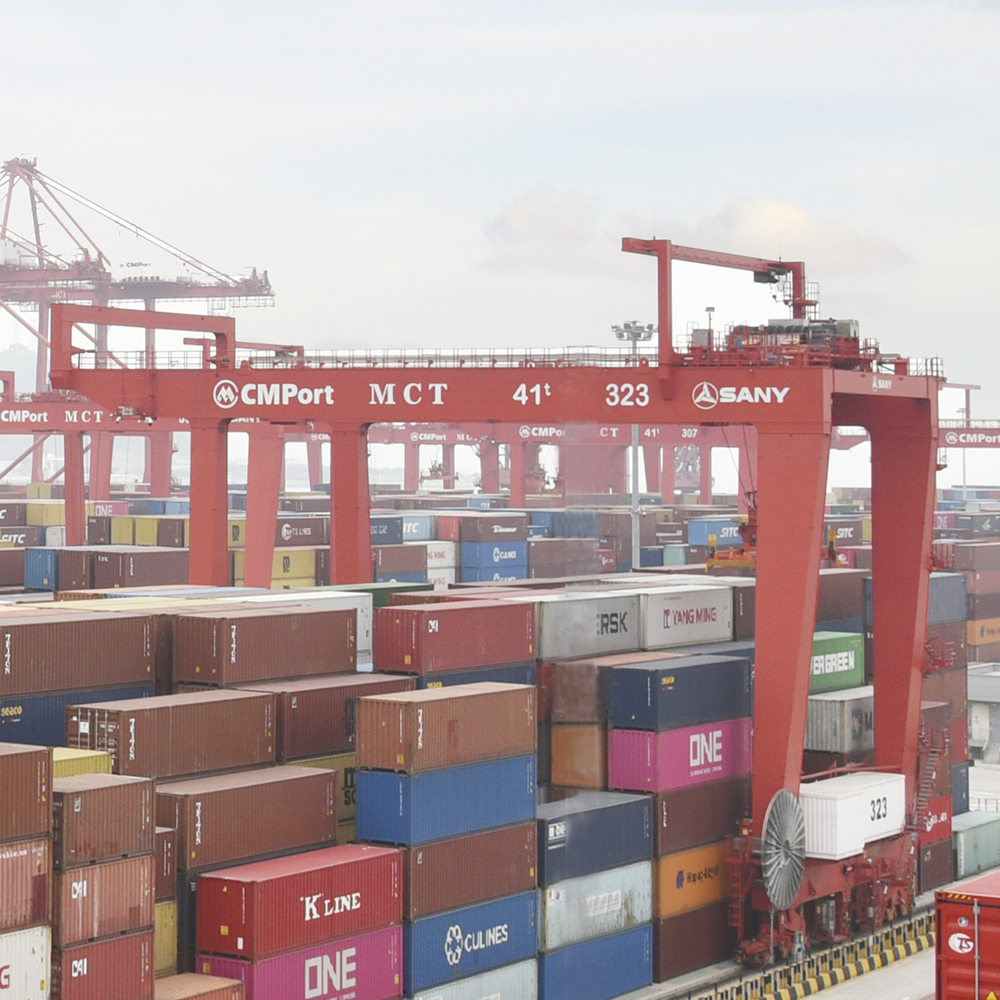
Rail-mounted container gantry crane automation
Rail-mounted container gantry craneRecommended products




0 comments