

Economics users: see the future of China's economy from the excavator industry
2017.03.06
At present, the momentum of large-scale infrastructure projects is still continuing, which may indicate that the main investment and industrial production data for January and February released in mid-March are also expected to exceed expectations. Infrastructure investment can still maintain a high rate, which in turn supports China's economy to maintain stable growth.
In February, both the official and Caixin PMIs exceeded expectations: the Bureau of Statistics PMI reached 51.6, up 0.3 percentage points from January, and the Caixin PMI rose to 51.7, the second highest in four years. The positive economic data is closely related to the continuous increase in infrastructure investment and the positive business activities of enterprises. Although the main macroeconomic data in January ~ February will not be released until mid-March, combined with the data of the high-frequency machinery industry and construction vehicles, this year's investment started earlier than expected, or will support the economy to maintain a recovery trend in the first half of the year.
Although the Spring Festival in January is the traditional off-season for the start of engineering projects, the excavators used for mechanical engineering are not in the off-season. In terms of sales, on the basis of a year-on-year increase of 70% in sales in the past four months, excavator sales in the off-season in January also reached a rapid growth of 54%; Since the second half of last year, excavator output has gradually increased, and the year-on-year growth rate of output in December 2016 reached 65.4%, a new high since February 2011.
The excavator industry is not accidental, as an important barometer of the degree of activity in the operation of the project, the supply and demand of the excavator industry is only a microcosm in the author's opinion, behind which is actually the government's steady growth policy since the middle of last year, and the effect of the positive financial and real estate investment has been significantly improved. In fact, although China's macro data has rarely changed throughout last year, especially the GDP data is almost in the range of 6.7%~6.8%, more and more micro data show that since the third quarter of last year, China's infrastructure and real estate investment have been driving economic growth more and more strongly.
Confirmed by the boom in the excavator industry, the market performance of heavy-duty trucks has also been eye-catching since the third quarter of last year. According to the data released by the China Association of Automobile Manufacturers, the growth rate of production and sales of heavy trucks in January was 87.62% and 125.15% respectively, both of which were new highs in the past six years. Looking back at the last round of the heavy truck industry so hot, it can be traced back to 2010, when China launched large-scale economic stimulus and increased infrastructure investment to resist the global financial crisis.
From a cyclical point of view, the excavator industry is highly overlapping with the macroeconomic boom cycle. For example, from the perspective of the relationship with industrial added value, in 2008~2010, economic fluctuations were first hit by the impact of overseas financial crises and fell sharply, and then benefited from a significant rebound in economic stimulus plans. During the same period, the sales of excavators in 2008 at 105% growth rate quickly fell to the end of 2008 -33%, but since the second half of 2009 there has been a positive growth, until the end of the year rebounded to 136%.
However, since the second half of last year, the excavator market has been hot, but the industrial added value data has not improved significantly, and the situation of the two has diverged. As the author mentioned in the September 2016 article, there were inconsistencies between the macro and micro data last year, with weak industrial growth, but better power generation, sharp increases in profits of industrial enterprises, continued freight traffic, and higher PMI data. The national fixed asset investment data continued to decline, but if the outliers of Liaoning Province are excluded, the investment growth rate remains high.
On the whole, the author believes that micro data such as profits, freight volumes, and sales of machinery products are more sensitive to market changes, and are difficult to whitewash and more credible, and their positive positive shows that the economic recovery is actually stronger than expected.
At present, the current infrastructure investment is still unabated, mainly reflected in:
First, the approval of infrastructure projects is still relatively fast. In January, the National Development and Reform Commission approved a total of 18 fixed asset investment projects, with a total investment of 153.9 billion yuan, nearly three times that of the same period last year, and the projects were mainly concentrated in the fields of water conservancy, transportation, and energy. The national railway has invested more than 800 billion yuan for three consecutive years;
Second, the enthusiasm for cooperation in PPP projects is high. As of the end of last year, the amount of PPP investment reached 13.5 trillion yuan, and there were no projects in the identification stage and transfer stage of 11,260 projects, indicating that the follow-up support for investment is expected to continue.
Third, policy banks still have a strong support for infrastructure. The special construction fund began in August 2015, with the China Development Bank and the Agricultural Development Bank issuing special construction bonds to the Postal Savings Bank, and the central government discounted the interest rate, aiming to solve the problem of insufficient capital for major projects. According to media reports, seven batches of funds have been arranged in the past two years, with an amount of more than 2 trillion yuan. At the same time, the PBOC's issuance of collateral supplementary loans (PSLs) to policy banks continued, with the PBOC adding a total of RMB54.3 billion in net collateral loans to the three policy banks in January, bringing the balance of collateral supplementary loans to RMB2.1 trillion by the end of January.
Fourth, financial support has continued and local debt swaps have increased. In 2016, the scale of local bond issuance exceeded 6 trillion yuan, including 1.18 trillion yuan of new bonds and 4.87 trillion yuan of existing replacement bonds. At present, there are still 6.27 trillion yuan of stock debt waiting to be replaced, and the author expects that in 2017, the stock replacement work will continue to be increased, and the scale of local government bond issuance may be between 6 trillion ~ 7 trillion yuan. At the same time, with monetary policy slightly tighter than last year, the fiscal deficit ratio is expected to further increase to around 3.5% this year.
Fifth, local governments have led the explosive growth of funds. It has been reported that the pace of the establishment of government guidance funds in many places has been significantly accelerated recently, and many places have put the active formation of government-guided industrial funds and the expansion of the scale of funds on the agenda. According to statistics, in 2016, 384 new government guidance funds were established, with a target scale of more than 3.1 trillion yuan, a year-on-year increase of 100.8% over 2015.
To sum up, it is not difficult to find that the current momentum of large-scale infrastructure projects is still continuing, which may indicate that the main investment and industrial production data released in mid-March from January to February are also expected to exceed expectations. Looking ahead, due to the impact of policy regulation and control of real estate investment this year, there is room for a pullback, but considering that a large number of infrastructure projects have started since last year, more than 10,000 PPP storage projects have not yet been delivered, and there is inertia in the later stage of project landing to drive investment, with the financial support of active finance, debt replacement and infrastructure special funds, the author expects that infrastructure investment can still maintain a high speed, thereby supporting China's economy to maintain stable growth.
Related testimonials
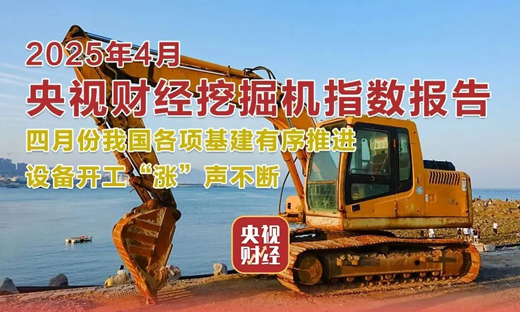
CCTV Finance × Sany Heavy Industry: Infrastructure results are released! Anhui is soaring, and the equipment of the western port has become a "dark horse"
2025.05.19

China's installed wind and solar capacity has historically surpassed that of thermal power
2025.04.28
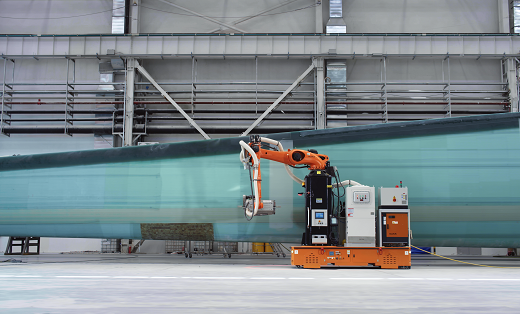
Breakthroughs have been made in the challenges of customization and high precision, and new progress has been made in the intelligent production of high-end equipment
2025.03.24




0 comments