

International Herald Leader - Sany Heavy Industry: Being concerned is because of dreams
2011.05.07
"We didn't know that our products would play a role in the Japanese nuclear crisis, because our pump trucks used to hit concrete, and we didn't expect to use them to fetch water."
"International Herald Leader" reporter Zhang Haowen Intern reporter Li Hui from Beijing There are no stars and no moon, and in the mountains behind the Hongyuan Machinery Factory in Hunan, four young people who have no jobs and no household registration have climbed to the top of the mountain in the dark with a bottle of wine and a chicken.
"In this life and this world, we will treat each other with all sincerity, share weal and woe, and vow to strive for the revitalization of the national industry......"
This happened in the fall of 1985, after four young people resigned from Hongyuan Machinery Factory and before starting their own business. The four people led by Liang Wengen are the founders of Sany Heavy Industry, and the story of Sany began with that blood oath.
At that time, China was still poor and not strong enough, while Japan, a neighbor with a strip of water, was so high-spirited and rich that it wanted to buy the whole world, so that European and American countries were very jealous and forced it to sign the "Plaza Accord".
Originally, the dream of Liang Wengen and others to revitalize national industry had nothing to do with Japan. However, 26 years later, it was Japan's Fukushima nuclear accident that tested their industrial dreams and brought "Made in China" to greater international recognition.
"Publicized, high-profile"
Because products are primarily found on construction sites rather than in the homes of ordinary consumers, companies in the heavy machinery sector rarely attract public attention. Sany is an exception.
In the aftermath of the Fukushima nuclear disaster, Japan tried its best to inject water into the nuclear power plant units to cool them down. Drawing on the experience of Chernobyl disaster relief, they considered using a pump truck to fill the unit with water.
After careful calculations, they need a 62-meter boomConcrete pump truck。 As a result, TEPCO sent a purchase intention to Sany Heavy Industries.
"When Japan makes such a request, it is only natural for us to respond *5656 by donating a piece of equipment, which is a humanitarian need." On April 13, Xiang Wenbo, president of Sany Heavy Industry Co., Ltd., told the International Herald Leader.
This 62-meter pump truck has brought Sany Heavy Industry to great public attention. However, in Xiang Wenbo's view, this is "publicized and high-profile", and for Sany, "being concerned" is more like an accident or accident.
"We didn't know that our products would play a role in a nuclear crisis, because our pump trucks used to hit concrete, and we didn't expect to use them to draw water." When Xiang Wenbo talked about this to reporters, his tone was relaxed, which caused laughter at the scene.
A similar "accident" occurred at the site of a mining disaster in Chile last year.
In October last year, a mining disaster occurred in Chile, when a crawler crane of Sany Heavy Industry was designated as disaster relief equipment by the disaster relief department.
"We didn't know that the equipment had arrived at the rescue site in advance, and it was only through media reports that we knew that our equipment was working in this area." Introducing to Wenbo.
However, after being "concerned", people naturally ask, why Sany Heavy Industry? Especially after this Fukushima incident in Japan. Because Japan itself is a big machinery manufacturing country, why would it purchase machinery and equipment from a Chinese private enterprise with a history of only more than 20 years?
The 66-meter pump truck independently developed by Sany Heavy Industry set a Guinness World Record in 2007, and in 2009, Sany set its own record by increasing the boom of the pump truck to 72 meters.
The 2010 world concrete machinery industry statistics released by international industry consultant Yengst on April 18 can explain why TEPCO chose Sany Heavy Industry from another aspect: In 2010, Sany Heavy Industry ranked 5656th in the world with annual sales of 2.72 billion US dollars in concrete machinery, and won the first place in the world.
From layman to industry
It may sound a little incredible, the four founders of Sany, including Xiang Wenbo, who joined later, are not from a mechanical background, but in more than ten years, they have achieved the world's *5656.
In 1994, the output value of the enterprise founded by Liang Wengen and others has exceeded 100 million. But because their main business - non-ferrous metal materials - the market is narrow, after some research, Liang Wengen, the current chairman of Sany Heavy Industry, decided to lead his team into the huge construction machinery manufacturing industry.
At that time, on the construction site in full swing, it was difficult to see construction machinery belonging to China's own brand. In this field, more than 95% of the products are "foreign goods". More than 10 years later, foreign brands in this field have exceeded 5%, and the other more than 95% of the market is occupied by Chinese enterprises of Sany Heavy Industry, which occupies nearly 60% of the market share.
When I first entered this field, all the core technologies of construction machinery were in the hands of European and American giants. At that time, whether it was buying technology or cooperating with foreign capital, for Sany, it was "this way out". Because Sany found that Western technology was not completely suitable for the Chinese market, and cooperation with foreign capital, whether in terms of scale or fame, Sany at that time could not enter the eyes of foreign giants. There is no other way to go, except for independent research and development.
"In the past ten years, we have developed 38 products from the 'layman' of construction machinery, not simply the development of quantity, but the development of high quality, in many product areas we have achieved the Chinese market * 5656, some are also the world * 5656." Xiang Wenbo told the International Herald Leader that the company invests 5%~7% of its sales revenue in R&D every year, while its European and American counterparts usually invest no more than 3%. At the same time, Sany Heavy Industry has a R&D team of more than 5,000 people.
"Such a huge R & D team is rare in the construction machinery industry, very simple, the pressure to pay more than 5,000 R & D personnel is very great, Europe and the United States these companies have no way to bear." Xiang Wenbo said.
As for the "technological innovation" of the enterprise, Liang Wengen has never hesitated. He did his best to *5655 possible to provide R&D personnel with relaxed conditions, not only in terms of R&D expenses, but also in terms of the environment.
In the early days of Sany's entry into the field of construction machinery, R&D coach Yi Xiaogang boldly designed a high and low pressure switching valve that can rotate 90 degrees for the concrete trailer pump, but was unanimously opposed by the workers to the workshop director. Because at that time, foreign brands all used pipes, and everyone couldn't understand why they should change it?
And this matter was supported by Liang Wengen's clapping. Eventually, a hydraulic manifold with a completely different working principle from the original product was designed. Sany Group's *5656 patents were born.
The boom technology of the pump trucks involved in the Japanese disaster relief was originally in the hands of German and American companies. After arduous R&D and innovation, Sany finally mastered this technology in 1998 and developed the first domestic boom pump truck with independent intellectual property rights.
In the industry, it is known as "the arm length increases by 1 meter, it is difficult to go to the blue sky", and with a strong R&D team, the boom of Sany pump truck has increased from 37 meters to 72 meters.
A company with dreams
Many people speculate about the origin of the name "Trinity", and the outrageous speculation is that it is called "Trinity" because three men and a woman founded the company.
For Liang Wengen's team, "Sany" is actually the embodiment of their ideals: "to create a first-class enterprise, create first-class talents, and make first-class contributions", which is the concept that Liang Wengen wrote on the wall at the beginning of his business, and "Sany" is also named after it.
Over the years, Sany has often been concerned by the media and has repeatedly become the focus of public opinion. Whether it is the share reform in 2005, or the questioning of Carlyle's acquisition of XCMG in 2006, or even the zero annual salary of senior executives since then, Sany will be questioned for being too "sharp". Even if it is the last two times to participate in the disaster relief in Chile and Japan, some people have questioned that Sany is suspected of "advertising".
And Liang Wengen believes that everything is a misunderstanding from the outside world, and the reason why Sany has repeatedly stood at the forefront is because it is a company with industrial dreams. Sany's industrial dream is the blood oath of the year: to revitalize the national industry.
In 2006, Carlyle wanted to acquire XCMG, and Xiang Wenbo, then the CEO of Sany Heavy Industries, wrote a series of articles on his blog, with a sharp style, pointing out that Carlyle's acquisition of XCMG Machinery was a "beautiful lie", and the core point was that XCMG sold state-owned assets cheaply; The value that Carlyle brings to XCMG is nothing but money; Xu work is a strategic industry and a leading enterprise cannot be controlled by foreign capital......
Because Xiang Wenbo continued to publish blogs, the acquisition faced huge public pressure and finally failed.
Two years later, Liang Wengen once criticized in an interview with reporters: "XCMG incident, even if it brings any losses to Sany, we do not regret it, this is the national interest." At that time, Mr. Xiang and I walked and chatted together, and this is what I said in private. ”
The dream is destined to achieve a different Sany Heavy Industry.
"About a year ago, I was stunned when I *5656 visited Sany Heavy Industry's concrete pump factory in Changsha, China." On January 28 this year, Hermann Simon, one of Europe's most famous management gurus and a German management scientist, wrote in the Financial Times that unlike the vast majority of Chinese manufacturing companies that rely on low cost to win, he found a "change in the opposite direction" in Sany: with first-class ambitions, first-class equipment and technology, it has become a strong competitor in the global market.
A reporter from the Wall Street Journal of the United States also had similar feelings after visiting Sany's factory: "The Sany factory located near Changsha Airport can be described as spotless, and anyone who comes to visit Sany can feel a strong sense of pride in the company." Because Sany has used equipment such as the pump truck it sent to Japan to drive the development of the construction machinery industry. ”
Simon even sees Sany as an "invisible * army" company, which, although few of them, will make China truly "Germany's future competitor".
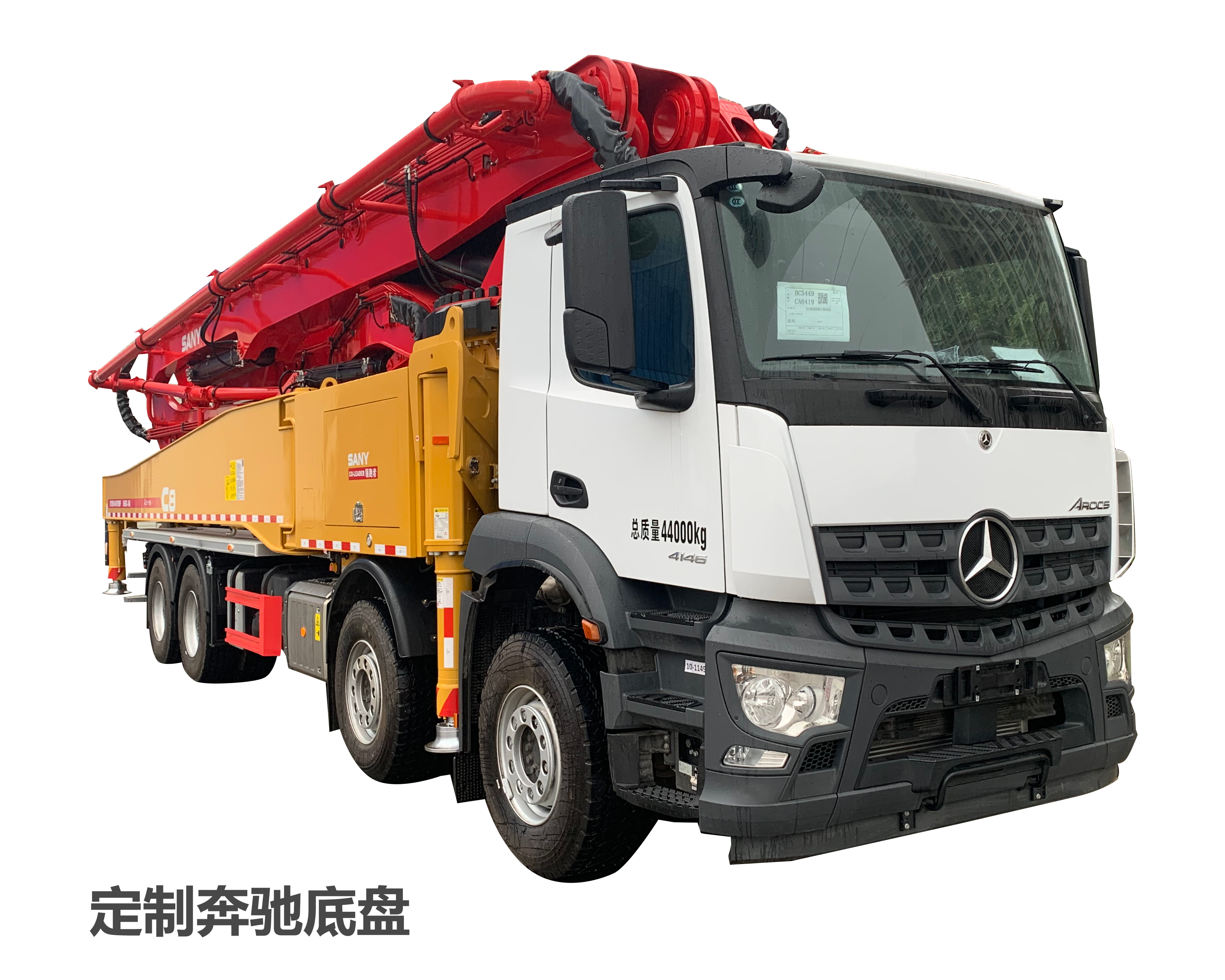
Concrete Pump Truck SYM5449THBF 560C-8A
Concrete pump truckRecommended products
SYM5449THBF 560C-8A
Concrete Pump Truck SYM5449THBF 560C-8ARelated testimonials
CCTV Finance × Sany Heavy Industry: Infrastructure results are released! Anhui is soaring, and the equipment of the western port has become a "dark horse"
2025.05.19
China's installed wind and solar capacity has historically surpassed that of thermal power
2025.04.28
Breakthroughs have been made in the challenges of customization and high precision, and new progress has been made in the intelligent production of high-end equipment
2025.03.24




0 comments