
Earth-moving machineryConcrete machinerycraneRoad machineryPiling machineryCoal machineryPort machineryWind power equipmentSany heavy truckTrinity ConstructionPetroleum equipmentTrinity EnvironmentEnvironmental engineeringEmergency rescue equipmentMining dump truckstip truckAerial work machineryLithium battery equipmentWarehousing and logisticsPhotovoltaic productsHydrogen equipmentCrushing equipment
Micro-diggingSmall diggingMedium diggingBig diggingWheeled excavatorsLoaderDiversify your productsAttachments
Pump trucksMixer trucksConcrete batching plantOn-board pumpsElectric vehicle on-board pumpsTow pumpMortar pumpsWet sprayerFilling pumpsNew energy mixer truckDry mix mortar mixing plantMortar/concrete dual-purpose batching plant
Truck cranesAll-terrain cranesTruss boom crawler craneTelescopic crawler craneMultifunctional crawler craneFlat-top tower craneTruck-mounted cranes
Reach stackerContainer empty container handlersforkliftGrab steel (material) machinePure electric port tractorTelehandlersShore-to-shore container cranesRail-mounted container gantry craneRubber-tyred container gantry craneGantry crane
3.X Medium and low wind speed wind turbines4.X Medium and high wind speed / all-weather / customized product platform5.X-6. X MW customized product platform
Smart PC equipmentIntelligent AAC equipmentIntelligent steel processing equipmentMobile crushing and screening equipmentMould fixturesCategory 2 standards3 soft 1 platform
Mechanical fracturingElectric fracturingOil-connected equipmentWellhead automationOilfield machineryFracturing pumps
Pure electric road cleaning vehiclePure electric solid waste collection and transfer vehicleMunicipal maintenance vehicles
Compressed air foam fire truckdroneSpecial-duty fire trucksCombat logistics support fire trucksRaise jet fire trucksAscending platform fire truck
High-speed homogenization systemDouble-layer extrusion coaterRoller pressing and slitting machineZ-type cutting and stacking machineWinding machinePrimary and secondary injection machinesCompound capacity needle bedModule PACK line

Earth-moving machineryConcrete machinerycraneRoad machineryPiling machineryCoal machineryPort machineryWind power equipmentSany heavy truckTrinity ConstructionPetroleum equipmentTrinity EnvironmentEnvironmental engineeringEmergency rescue equipmentMining dump truckstip truckAerial work machineryLithium battery equipmentWarehousing and logisticsPhotovoltaic productsHydrogen equipmentCrushing equipment
Micro-diggingSmall diggingMedium diggingBig diggingWheeled excavatorsLoaderDiversify your productsAttachments
Pump trucksMixer trucksConcrete batching plantOn-board pumpsElectric vehicle on-board pumpsTow pumpMortar pumpsWet sprayerFilling pumpsNew energy mixer truckDry mix mortar mixing plantMortar/concrete dual-purpose batching plant
Truck cranesAll-terrain cranesTruss boom crawler craneTelescopic crawler craneMultifunctional crawler craneFlat-top tower craneTruck-mounted cranes
Reach stackerContainer empty container handlersforkliftGrab steel (material) machinePure electric port tractorTelehandlersShore-to-shore container cranesRail-mounted container gantry craneRubber-tyred container gantry craneGantry crane
3.X Medium and low wind speed wind turbines4.X Medium and high wind speed / all-weather / customized product platform5.X-6. X MW customized product platform
Smart PC equipmentIntelligent AAC equipmentIntelligent steel processing equipmentMobile crushing and screening equipmentMould fixturesCategory 2 standards3 soft 1 platform
Mechanical fracturingElectric fracturingOil-connected equipmentWellhead automationOilfield machineryFracturing pumps
Pure electric road cleaning vehiclePure electric solid waste collection and transfer vehicleMunicipal maintenance vehicles
Compressed air foam fire truckdroneSpecial-duty fire trucksCombat logistics support fire trucksRaise jet fire trucksAscending platform fire truck
High-speed homogenization systemDouble-layer extrusion coaterRoller pressing and slitting machineZ-type cutting and stacking machineWinding machinePrimary and secondary injection machinesCompound capacity needle bedModule PACK line
Sany Heavy Industry Sany Heavy Industry Co., Ltd. (SH:600031)
Trinity International Sany International (HK:00631)
Sany Renewable Energy Sany Renewable Energy (SH:688349)
Home > Industry information > The person in charge of the National Development and Reform Commission answered questions about the top-level design opinions of the central government on "carbon peak and carbon neutrality".
The person in charge of the National Development and Reform Commission answered questions about the top-level design opinions of the central government on "carbon peak and carbon neutrality".
2021.10.25
CWEA
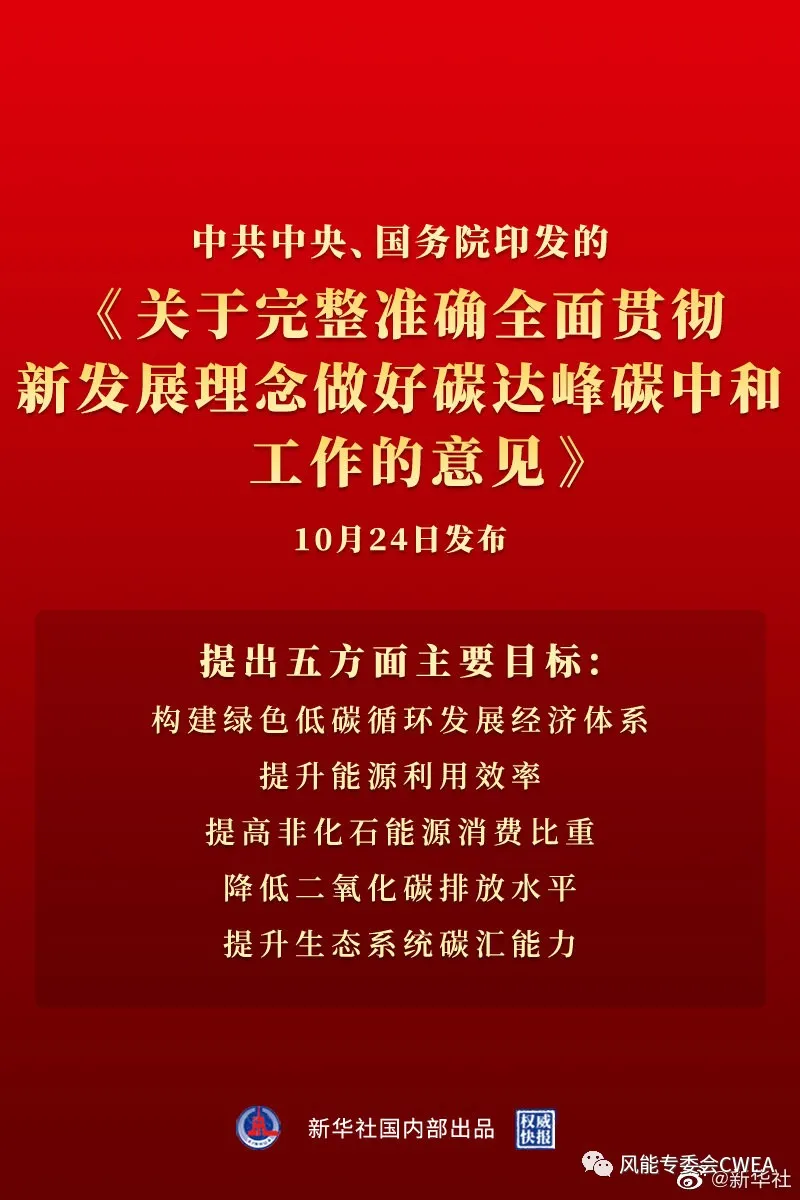
The "Opinions of the Central Committee of the Communist Party of China and the State Council on Completely, Accurately, and Comprehensively Implementing the New Development Concept and Doing a Good Job in Carbon Peak and Carbon Neutrality" was released on the 24th. What are the important arrangements for promoting carbon peak and carbon neutrality? The reporter interviewed the person in charge of the National Development and Reform Commission.
There is an urgent need for top-level design
Q: What is the background to the opinion? A: On September 22, 2020, General Secretary Xi Jinping announced at the General Debate of the 75th Session of the United Nations General Assembly that China would strive to peak carbon dioxide emissions before 2030 and achieve carbon neutrality before 2060. Achieving carbon peak and carbon neutrality is a major strategic decision made by the CPC Central Committee with Comrade Xi Jinping at the core after careful consideration, which is related to the sustainable development of the Chinese nation and the building of a community with a shared future for mankind. Achieving carbon peak and carbon neutrality is a broad and profound economic and social systemic change, facing unprecedented difficulties and challenges. At present, China's economic structure is still unreasonable, industrialization and new urbanization are still being promoted, the task of economic development and improvement of people's livelihood is still very heavy, and energy consumption will still maintain rigid growth. Compared with developed countries, China's time window from carbon peak to carbon neutrality is tight. To do a good job in carbon peak and carbon neutrality, it is urgent to strengthen top-level design. At the central level, it is of great significance to formulate and issue opinions on the systematic planning and overall deployment of the major work of carbon peak and carbon neutrality, further clarify the overall requirements, put forward the main goals, deploy major measures, and clarify the implementation path, which is of great significance for unifying the understanding and will of the whole party and gathering the strength of the whole party and the whole country to complete the arduous task of carbon peak and carbon neutrality.
Based on the actual target arrangement of the development stage and national conditions
Q: What is the main goal of the submission? A: The opinions put forward five main goals: building a green, low-carbon and circular development economic system, improving energy efficiency, increasing the proportion of non-fossil energy consumption, reducing carbon dioxide emissions, and improving the carbon sink capacity of ecosystems. By 2025, an economic system of green, low-carbon and circular development will take shape, and the energy efficiency of key industries will be greatly improved. Energy consumption per unit of GDP decreased by 13.5% compared to 2020; CO2 emissions per unit of GDP decreased by 18% compared to 2020; The proportion of non-fossil energy consumption reaches about 20%; The forest coverage rate has reached 24.1%, and the forest stock has reached 18 billion cubic meters, laying a solid foundation for achieving carbon peak and carbon neutrality. By 2030, the comprehensive green transformation of economic and social development will achieve remarkable results, and the energy efficiency of key energy-consuming industries will reach the international advanced level. Energy consumption per unit of GDP has dropped significantly; Carbon dioxide emissions per unit of GDP decreased by more than 65% compared with 2005; The proportion of non-fossil energy consumption has reached about 25%, and the total installed capacity of wind power and solar power generation has reached more than 1.2 billion kilowatts; The forest coverage rate has reached about 25%, the forest stock has reached 19 billion cubic meters, and carbon dioxide emissions have reached a peak and achieved a steady decline. By 2060, an economic system of green, low-carbon and circular development and a clean, low-carbon, safe and efficient energy system will be fully established, energy utilization efficiency will reach the international advanced level, the proportion of non-fossil energy consumption will reach more than 80%, the goal of carbon neutrality will be successfully achieved, and the construction of ecological civilization will achieve fruitful results, creating a new realm of harmonious coexistence between man and nature. This series of goals, based on China's development stage and national conditions, marks that China will complete the world's largest reduction in carbon emission intensity and achieve carbon neutrality from the peak of carbon emissions in the shortest time in history.
31 key tasks in 10 aspects, clear roadmap and construction drawings
Q: What are the main tasks and major initiatives proposed in the opinions? A: Achieving carbon peak and carbon neutrality is a multi-dimensional, three-dimensional and systematic project, involving all aspects of economic and social development. The opinions adhere to the system concept, put forward 31 key tasks in 10 aspects, and clarify the roadmap and construction drawings for carbon peak and carbon neutrality. The first is to promote the comprehensive green transformation of economic and social development, strengthen the guidance of green and low-carbon development planning, optimize the regional layout of green and low-carbon development, and accelerate the formation of green production and lifestyle. The second is to deeply adjust the industrial structure, accelerate the green and low-carbon transformation of agriculture, industry and service industries, resolutely curb the blind development of high-energy-consuming and high-emission projects, and vigorously develop green and low-carbon industries. The third is to accelerate the construction of a clean, low-carbon, safe and efficient energy system, strengthen the dual control of energy consumption intensity and total amount, greatly improve energy efficiency, strictly control fossil energy consumption, actively develop non-fossil energy, and deepen the reform of the energy system and mechanism. Fourth, accelerate the construction of a low-carbon transportation system, optimize the transportation structure, promote energy-saving and low-carbon transportation, and actively guide low-carbon travel. Fifth, improve the quality of green and low-carbon development of urban and rural construction, promote the low-carbon transformation of urban and rural construction and management models, vigorously develop energy-saving and low-carbon buildings, and accelerate the optimization of building energy consumption structure. Sixth, strengthen the research, promotion and application of major green and low-carbon scientific and technological research, strengthen basic research and cutting-edge technology layout, and accelerate the research and development and promotion of advanced and applicable technologies. Seventh, we will continue to consolidate and improve the carbon sink capacity, consolidate the carbon sink capacity of the ecosystem, and increase the carbon sink increment of the ecosystem. Eighth, we need to improve the level of green and low-carbon development in opening up to the outside world, accelerate the establishment of a green trade system, promote the green Belt and Road Initiative, and strengthen international exchanges and cooperation. The ninth is to improve laws, regulations, standards and statistical monitoring systems, improve the standard measurement system, and enhance statistical monitoring capabilities. Ten is to improve the investment, financial, fiscal and tax, price and other policy systems, and promote the construction of market-oriented mechanisms such as carbon emission trading and energy use rights trading.
Play a leading role in the "1+N" policy system
Q: What is the positioning and role of opinions in the "1+N" policy system for carbon peak and carbon neutrality? A: In May this year, the central government set up a leading group for carbon peak and carbon neutrality as a deliberative and coordinating body to guide and coordinate the work of carbon peak and carbon neutrality. The office of the leading group is located in the National Development and Reform Commission. In accordance with the unified deployment, we are accelerating the establishment of a "1+N" policy system and setting up the "four beams and eight pillars" of carbon peak and carbon neutrality. The opinions issued by the CPC Central Committee and the State Council, as "1", are in charge of the long-term and play a leading role in the "1+N" policy system of carbon peak and carbon neutrality; Together with the action plan for carbon peaking before 2030, the opinions will constitute a top-level design that runs through the two stages of carbon peaking and carbon neutrality. "N" includes the implementation plan for carbon peaking in sub-fields and industries such as energy, industry, transportation, and urban-rural construction, as well as guarantee plans such as scientific and technological support, energy security, carbon sink capacity, fiscal and financial price policies, standard measurement systems, and supervision and assessment. A series of documents will build a policy system for carbon peaking and carbon neutrality with clear goals, reasonable division of labor, strong measures, and orderly cohesion.
Ensure that the work of carbon peak and carbon neutrality has achieved positive results
Q: How to do a good job in the implementation of the opinions? A: Achieving carbon peak and carbon neutrality is an uphill battle, and it is also a big test of the party's ability to govern the country. The next step will be to fully implement the opinions and deployments to ensure that the work of carbon peak and carbon neutrality achieves positive results. The first is to accelerate the establishment of a policy system for carbon peak and carbon neutrality. Guide local governments to scientifically formulate implementation plans for carbon peaking, and promote all parties to do a good job of carbon peaking and carbon neutrality in an orderly manner. The second is to strengthen overall coordination and supervision and assessment. The National Development and Reform Commission will earnestly perform the responsibilities of the Office of the Leading Group for Carbon Peak and Carbon Neutrality, track and regularly schedule the progress of work in various regions and fields, and do a good job in the supervision and assessment of the implementation of various goals and tasks. The third is to organize and carry out a pilot demonstration of carbon peak and carbon neutrality. Support qualified localities, key industries, and key enterprises to actively explore, and form a number of effective models that can be replicated and promoted, so as to provide useful experience for achieving the goal of carbon peak and carbon neutrality at the national level as scheduled.
0 comments
Related testimonials
CCTV Finance × Sany Heavy Industry: Infrastructure results are released! Anhui is soaring, and the equipment of the western port has become a "dark horse"
2025.05.19
China's installed wind and solar capacity has historically surpassed that of thermal power
2025.04.28
Breakthroughs have been made in the challenges of customization and high precision, and new progress has been made in the intelligent production of high-end equipment
2025.03.24




0 comments