

Global oil shortages are inevitable and supplies are chronically insufficient
2021.11.01
Petroleum Business Daily
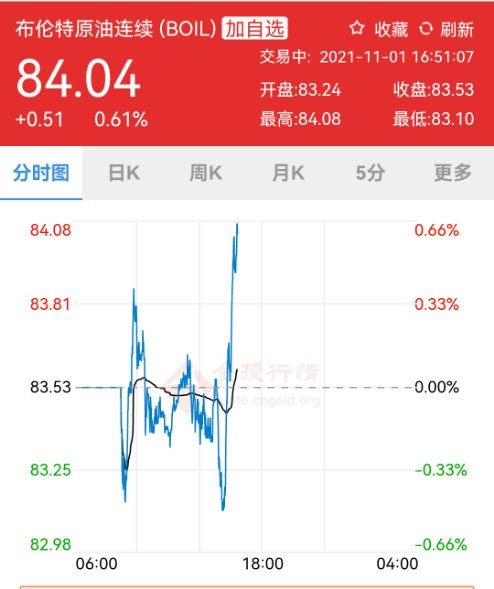
Since the beginning of 2020, oil prices have achieved a shocking reversal, and prices have continued to rise. As of November 1, 2021, Brent crude oil was at $84.04 per barrel, up 50.37% from the beginning of the year.Oil prices have been rising, and the global energy crisis has intensified.
Analysts say that since the 2015 oil crisis, chronic underinvestment in new oil supplies, as well as pressure on oil and gas companies to control emissions or even "mothball them underground," could lead to an earlier peak in global oil production, according to the U.S. Oil Price website.
If it weren't for the simple fact that oil demand is rebounding from the pandemic-induced downturn and will set a new annual average as soon as next year, it would be a welcome development for green energy advocates, the net-zero agenda, and the planet as a whole.
The energy transition and the government's various net-zero plans have prompted analysts to predict that peak oil demand will occur sooner than expected a few years ago. However, as oil and gas investment tends to stagnate at the moment, global oil supply is likely to peak sooner than global oil demand, creating a supply gap that will lead to increased volatility in the oil market, a spike in oil prices, and the possibility of a structural rise around 2030.
Supply may peak before demand
Morgan Stanley Research wrote in a Reuters report this week: "On current trends, global oil supply is likely to peak sooner than demand." ”
Morgan Stanley analysts said: "The Earth sets boundaries for the amount of carbon that can be safely emitted. Therefore, oil consumption needs to peak. ”
The problem for the world is that oil consumption (wishful thinking, investor pressure, etc.) has not peaked. Most estimate that it won't peak until the end of the century at the earliest.
According to OPEC's latest annual outlook, the group expects global oil demand to continue to grow to 108 million b/d in the mid-30s before remaining flat until 2045.
Some other analysts expect demand to peak in the late 20s.However, investment in new supply has seriously lagged the growth of global oil demand.Demand grew again after the 2020 COVID crisis, and contrary to some expectations at the beginning of 2020, world oil consumption will never return to pre-pandemic levels, and demand is now only a few months away from reaching and exceeding these levels.
The supply gap will loom in the coming years
On the other hand, outside the scope of the OPEC+ deal, supply appears to be constrained.New investment fell to a 15-year low last year. Global upstream investment fell to $350 billion last year, the lowest level in 15 years, according to estimates earlier this year by Wood Mackenzie, a prominent consultancy.Despite the fact that oil prices are as high as $80, investment is not expected to increase significantly this year. That's because the mega-oil majors adhere to capital discipline and commit to net-zero emissions targets, which some of them plan to achieve by restricting investment and developing non-core, barely profitable new oil projects.Given that oil demand will continue to grow, underinvestment in new supply will be a major problem in the medium to long term, at least for the next few years.Despite the energy transition, demand will not disappear, and new supplies will be needed to replace declining production and reserves in the coming years.OPEC said the oil industry will need significant investment over the next 25 years to meet demand. OPEC said the industry will need a cumulative $11.8 trillion in long-term upstream, midstream and downstream oil-related investments by 2045.
France's TotalEnergies chief executive Patrick Pouyanné told an energy intelligence forum this month that oil prices would "soar to the top" by 2030 if the oil industry stops investing in new supply, as some scenarios for net-zero by 2050 suggest. "If we stop investing in 2020, we're going to leave all these resources in the ground......," Pouyanné said Then the price will skyrocket. Even in developed countries, this is a big problem. ”
The price of oil at $100 per barrel,No longer an outrageous prediction.Francisco Blanch, global head of commodities and derivatives research at Bank of America, expects oil prices to hit $100 in September 2022 and could hit $100 sooner if temperatures are much lower than expected this winter.Even if oil prices cannot be sustained at $100 per barrel, however, future supply tightness will still push oil prices higher, leading to unsustainable price spikes. While climate activists want to stop investing in new supply, the oil industry and the world can't afford it as oil demand continues to grow.
Related testimonials

CCTV Finance × Sany Heavy Industry: Infrastructure results are released! Anhui is soaring, and the equipment of the western port has become a "dark horse"
2025.05.19
China's installed wind and solar capacity has historically surpassed that of thermal power
2025.04.28
Breakthroughs have been made in the challenges of customization and high precision, and new progress has been made in the intelligent production of high-end equipment
2025.03.24




0 comments