

"Wind Energy" column丨Zhang Shuwei: What is the flexible adjustment ability of the power system? ——Let's start with a brokerage report
2024.06.18
Wind Energy Committee CWEA
- Flexibility not only includes the technical characteristics of a single coal power start-stop time, ramp-up rate and minimum output, but also a systemic problem of start-up combination.
- Many relevant studies at home and abroad have shown that there is no theoretical or empirical basis for the suggestion that 15% wind and solar share corresponds to the critical point of a significant increase in system cost.
- The author has a tendency hypothesis: the greater reason for the lack of regulation capacity of China's power system lies in the start-up combination, rather than the lack of flexible power supply.
On January 27, the National Development and Reform Commission and the National Energy Administration jointly issued the "Guiding Opinions on Strengthening the Construction of Power Grid Peak Regulation Energy Storage and Intelligent Dispatching Capacity"1, focusing on the improvement of the intelligent dispatching capacity of the power system, and putting forward requirements for operation, technology, and demand side. In the 3,000-plus-word document, the word "flexible" appears eight times and the word "regulating" 32 times. This inevitably involves the so-called "flexible adjustment ability of the power system" mentioned in various articles and reports in the past.
In this column, we will use examples to explain what flexibility is and why the definition of the concept of "absorption capacity" contains significant methodological flaws.
Brokerage reports help us understand how boot portfolios hinder system flexibility
At the beginning of 2024, in the analysis report entitled "How to Understand the Consumption Space of the Power System for New Energy", a brokerage institution gave the following methodology 2: "The minimum technical output of the new conventional power supply installed capacity is increased by 10GW/3GW/2GW of the new nuclear power/coal power/gas power minimum technical output to compress the consumption space." ”
This is a surprising methodology. The addition of power supply actually means that the regulation range of the power system is reduced.
Unfortunately, however, this is most likely the paradigm of the current power system – a huge amount of (hot) reserve to cope with fluctuations in demand and various other uncertainties. The Technical Regulations for the Design of Power Systems (Trial) (SDJ161-85) stipulates that the total standby of the system (including load standby, accident standby and maintenance standby) shall not be less than 20%. The Technical Guidelines for Power Systems (GB/T38969-2020) issued in 2020 stipulate that the system (thermal) reserve capacity is 2%~5% of the maximum load, and the accident reserve capacity is 10% of the maximum load, which is not less than the single-stage capacity of one largest unit of the system or the maximum capacity of DC feeded into the system. Although there is this regulation, from the above way of thinking, the actual start-up combination is not to maintain a minimum standby rate that is necessary and not wasted, but theoretically all units are "prepared" with the minimum output, and then raised when necessary. In other words, if the peak-to-valley difference is 50%, and the hot backup rate is 7%3 at peak times, then the backup rate up the valley is 55%.
Extremely high standby rates, the ability to regulate in the other direction is not good news. The units are all in the system, and the pass
Often, each unit has a minimum output limit, so when encountering a large wind and light, the ability to further decline is bound to be limited.
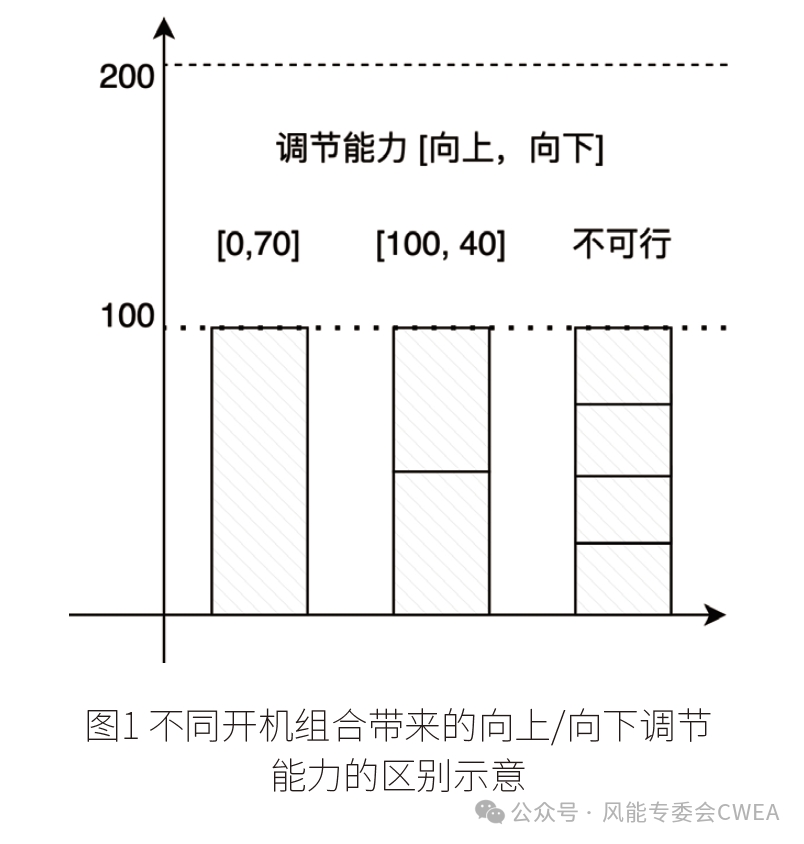
To take a schematic example (Fig. 1), if the demand is 100 and can be met by 1 unit with 100 quota power, the further upside potential is 0 and the downside potential is 70 (the minimum stable combustion output is 30%). However, if it is met with 2 units with 100 quota power (50 output per unit), the upside potential is 100 and the downside potential is 40. If 4 units with 100 quota power are used (each unit has an output of 25), then the start-up combination will be unsolvable, because there is no unit that can press the output to 25.
You need to pay attention to the boot combination
The flexibility of coal-fired power units has been changed from 50% to 30% of the minimum output, releasing only 20% of the adjustment capacity. The difference between a 50% minimum output level coal-fired power unit is to be "hot standby" in the system all the time, or whether it needs to be raised again, will be 50% of the capacity space. Flexibility is not only a technical feature of a single coal power start-stop time, ramp-up rate and minimum output, but also a systemic problem of start-up combination.
In order to be able to bring it up when it is "needed", it is an unavoidable problem to balance the system based on predictions and clear value criteria, and to decide which unit is on and which is down. If the system scheduling does not use wind power prediction information, it is easy to lead to over-scale start-up plans of thermal power units. On February 7, 2024, the National Development and Reform Commission and the National Energy Administration jointly issued the "Notice on Establishing and Improving the Market Price Mechanism for Power Ancillary Services"4 emphasizing that power grid enterprises should strengthen refined management and improve the level of economic dispatching. We believe that this refers to both real-time economic scheduling and the earlier start-up combination plan.
Nonsense: 15% of the wind share corresponds to the tipping point of a significant increase in system costs, but 15% does make sense
Another important figure is 15%, which corresponds to the turning point of "the rapid rise in the cost of wind and solar access to the grid" claimed by some industry interest groups, and also corresponds to the proportion of wind and solar realization in 2024/2025.
Article 5 has pointed out: "Studies at home and abroad have shown that after the penetration rate of new energy exceeds 10%~15%, the system cost will enter a critical point of rapid growth, and it is difficult to completely offset the increase in the system cost paid by absorbing new energy in the future." ”
Many domestic and international studies have shown that there is no theoretical or empirical basis for this boundary. Our national-scale simulations show that, on average, the rise in the proportion of wind and solar to 32% is the tipping point for the "net" incremental cost of the system, which has been an economically rational choice and has since been a gradual increase at the system level, rather than a "rapid rise" that is not precisely defined.
Even the study of "fluctuating power access capability" more than 10 years ago, when the cost of wind and solar and the level of system automation were not as good as they are today, were far more optimistic than 15%. For example, the 2011 (already 13 years ago) special report of the United Nations Intergovernmental Panel on Climate Change (IPCC) summarized the experience of major Organisation for Economic Co-operation and Development (OECD) member countries in the development and operation of wind power,6 and the technical challenges brought to the system by wind power integration within 20% of the electricity generation share are not insurmountable, and the increase in costs is manageable. At present, on the one hand, the long-term LCOE of renewable energy is lower than that of traditional fossil energy such as coal, and the difference is 30%~50% of the total cost. This cost advantage is more than offset by the increase in system costs, such as the volatility of renewables leading to lower utilization of other units (profile cost) and the uncertainty leading to a slight increase in backup and operating reciprocal costs (reserve cost).
However, the figure of 15 per cent is clearly "calculated". At present, hydropower and nuclear power together account for about 20%, natural gas accounts for 5%, and the rest of the space is coal-powered. Except for the time of photovoltaic power at noon, the output of coal power changes at 60%~90%, which can basically meet the requirements of all times of the day. At this level, too much backup will not challenge the physical minimum output limit, and the system operation will still maintain the feasibility of the existing paradigm.
Therefore, the discussion on the flexible adjustment capacity of the power system in China must pay special attention to the system level, rather than the technical indicators of a single unit. Scheduling should change the system balance model from the role of "commander" to that of an equal market participant, using a combination of prediction and accurate start-up rather than a huge amount of backup to balance the system.
Back to the basic definition: flexibility isn't just about technology
In terms of basic definition, power system flexibility tends to refer to the ability to maintain the reliable operation of a power system under a wide range of conditions. The volatility and uncertainty of renewables require greater flexibility in the power system. It is believed that readers will find these two claims or statements in a large number of domestic and foreign literature in the past 15~20 years, which belong to the language of standardized, general policy documents, reports and even journal articles, and also correspond to many policy recommendations, activities and collective initiatives. For example, in 2017, the 8th Clean Energy Ministerial Conference (CEM8) made "power plant flexibility" a central topic for campaigning.
In 2022, the International Hydropower Association (IHA) launched a series of events under the theme "We can, with hydropower", which continues to focus on flexibility. In 2023, National Grid convened more than a million households and businesses to sign up to measure demand-side flexibility. In March 2024, Germany and France agreed to jointly study the elements of their flexibility policies, including demand-side response, battery storage and dispatchable capacity capacity, and grid infrastructure, in line with climate neutrality targets. In China, in 2021, State Grid Electric Vehicle Service Co., Ltd. will build 42 vehicle-to-network interactive (V2G) projects and 609 V2G terminals in 15 provinces (cities), and a total of nearly 4,000 electric vehicles have participated in vehicle-to-network interactive tests, providing flexibility for the power system.
They are applicable to a wide range of situations and occasions, and the author does not disagree with them. However, due to their lack of precise definition of time, space and frame of reference, the so-called "flexibility" is compared to what, how much demand it means, and what incentives and constraints supply faces, but it inevitably lacks details and relevance to reality, and thus degenerates into an "unanchored" discussion. The discussion on flexibility needs to move beyond a technical lens and into a systems methodology and perspective.
The paradox in reality: investment spillovers tend to outweigh operational spillovers
The paradox and dilemma of reality is that investment is often what everyone is happy to see, and as long as there is investment, the upstream and downstream of the industrial chain will benefit. It is undoubtedly wishful thinking to ask those who enjoy the impact of investment spillovers, such as the above-mentioned brokers, to consider the sustainability of their operations, as well as the spillover effects of their operations, especially on transformation, the environment, the local economy and even employment.
How do you design a mechanism to get more attention and focus on operational issues? This tests the design and promotion of China's new power system and new energy system. After all, for society as a whole, it is not only the investment that makes sense, but also how the invested assets are operated is the key to long-term production performance and quality of life.
brief summary
The expression of "flexible adjustment ability of power system" is a way to generalize complex and detailed problems, which is semanticly necessary. However, this generalization also simplifies, obscures and technicalizes a comprehensive problem. The author has a tendency hypothesis: the greater reason for the lack of regulation capacity of China's power system lies in the start-up combination, rather than the lack of flexible power supply. We will leave this hypothesis to a precise quantitative test for the future.
On February 6, the National Development and Reform Commission (NDRC) and the National Energy Administration (NEA) issued guidance aimed at the high-quality development of the distribution network7. In particular, the guidance clarifies the work goals for 2025: the carrying capacity and flexibility of the distribution network will be significantly improved, with about 500 million kilowatts of distributed new energy and about 12 million charging piles.
On February 29, General Secretary Xi Jinping emphasized 8 at the 12th collective study of the Political Bureau of the CPC Central Committee: "It is necessary to adapt to the needs of energy transformation, further build a new energy infrastructure network, promote the intelligent transformation of power grid infrastructure and the construction of smart microgrids, and improve the power grid's ability to accept, allocate and regulate clean energy." "This puts forward clear requirements for China's next energy transition goals/constraints, infrastructure guarantees, and renewable energy grid integration goals.
In the short term, we still look forward to the improvement of relevant policies and regulatory measures as soon as possible. The author believes that this is undoubtedly a "clarion call" for a real energy revolution. Let us all look forward to, witness and participate in the great history ahead.
Rail-mounted container gantry crane automation
Rail-mounted container gantry craneRecommended products
automation
Rail-mounted container gantry crane automationRelated testimonials
CCTV Finance × Sany Heavy Industry: Infrastructure results are released! Anhui is soaring, and the equipment of the western port has become a "dark horse"
2025.05.19
China's installed wind and solar capacity has historically surpassed that of thermal power
2025.04.28
Breakthroughs have been made in the challenges of customization and high precision, and new progress has been made in the intelligent production of high-end equipment
2025.03.24




0 comments