

Chinese entrepreneur: Tang Xiuguo, President of Sany: The biggest challenge is whether you can know yourself
2011.11.22
Transferred from: Phoenix.com Source: Chinese entrepreneur Reporter: Du Liang
If Trinity's future is only a matter of wealth, we can even hand over part of our wealth to our children. However, the future of Sany is not a question of wealth, but a question of how to give full play to wealth
——Tang Xiuguo, President of Sany Group, talks about leadership training
Starting from a small welding material factory, after 22 years of development, Sany Group has become China's *5655 and the world's sixth largest construction machinery manufacturing enterprise. For an enterprise empire with 68,000 employees and nearly 4,000 cadres, its success is not only the success of the industry strategy, but also the cultivation of internal talents and the sustainable development of leadership.
It's a reckless private business, but it's not your typical family business. Tang Xiuguo is one of the four entrepreneurial veterans of Sany * early and is currently the president of Sany Group. The calm and introverted Tang is the "No. 2 person" of Sany and is recognized as the "master of the house". At the Sany headquarters, Tang Xiuguo introduced the experience of sustainable development of Sany leadership to China Entrepreneur.
Sany Group has developed so much in a field monopolized by a state-owned enterprise, and it must have a very solid foundation in the cultivation of leadership. You can say that you have witnessed the whole process, what kind of basic experience does Sany have?
Tang Xiuguo: Actually, Sany does not deliberately emphasize that there is a big difference between leadership and other management skills. We hope that Sany will truly be a humble organization. Mr. Liang wrote in a short article that when the CEO of Tata Steel was 65 years old, he said what great leadership is. It's humility. My understanding is that no matter how good you are, there is no better, only better. In fact, as long as we maintain the ability to continue learning, Sany can still do a little bigger than today, and can also accept stronger challenges. Some people joked that Liu Xiang's time improved from 14 seconds to 13 seconds, why is it so difficult to miss one second. But if he takes a year to improve, a little bit every year, he can do it. I want to be a business, and the same is true for developing leadership.
Of course, we still have to give employees an explanation, what exactly is leadership? I like Drucker's definition of management. What does he say is management? Business management is all about defining the goals of the business and then organizing and motivating your team to achieve that goal. Defining the goals of the business is the mission of the entrepreneur, and motivating your team to achieve that goal is the realm of leadership, and the two add up to management.
And one more thing that is very interesting. Many years ago, we said that we should build marketing and service into our core competitiveness. But one employee said that none of these were the things. He said that Sany's core competitiveness is that Mr. Liang is more generous. What is the meaning of "generous"? In fact, he will have a lot of followers. In the past, we said that only when money is tempting can a career be cohesive. Now, of course, it doesn't look like that's exactly the case. Today, money may not be all about allure.
Therefore, Mr. Liang is indeed building an organization with continuous learning ability. He's working on building the organization into a group with a large following, not what we used to say was four people, and it's going to be four or forty people in the future. A large number of people identify with him and follow him, and this organization is able to motivate them to pursue great goals together. That's what we understand as leadership.
You just talked about the qualities of humility and generosity, in fact, just now we listened to your comrades from the Human Resources Department share some of Sany's practices, in fact, they also talked about lofty ambitions and ideals, and strive for the take-off of the Chinese nation, which is a very important thing to unite people's hearts?
Tang Xiuguo: What you said is very, very important. Gardner's book "On Leadership" mentions that there are actually 9 tasks for leadership,*5656 are goals, the second is values, the third is motivation, and the fourth is management.
What kind of goals can motivate employees, there is a saying that bold goals can motivate employees. It may have been unthinkable that people are actually striving for such an ambitious goal, but when we form common values and motivate everyone, we feel that it is possible. At this time, people can be said to have reached a critical state, and this critical state is * able to stimulate people's potential.
Today, money may still have some cohesion. But what is more important? It is indeed the pursuit of the cause that is important.
Back then, the four of you, "Liang Yuan, Mao Tang", "became brothers" on a hill and started a business together. Looking back on that scene today, are there any changes in mentality?
Tang Xiuguo: At that time, we emphasized that Sany's success should not be just a career success. Even if we have a lot of money, if the four of us don't do happily and break up, it can't be said to be a success. Our goal is to really create a testing ground for business management in China. This goal is not only the success of the cause, but also the success of our cooperation, which is a premise. Why did we emphasize this at the time? Because I feel Chinese culture. Some people say that when Chinese play mahjong, they take care of themselves and guard against others, and the spirit of cooperation is less. Do we think that Chinese culture is really less cooperative? Not necessarily. However, if you repeatedly reinforce negative things, it is likely that everyone will think that Chinese culture is really like this. We feel that we should not strengthen it in this way, but should strengthen the spirit of cooperation among the Chinese. You see, the Chinese nation is relatively not afraid of great disasters and disasters, and the Chinese cannot be defeated in the face of any major disasters. When we decided to start a business at that time, although there was no catastrophe, it was still very tragic, nothing, four people together, what to eat? What to drink? If the gang is dispersed, it is equivalent to nothing. At least we are together, as long as we are together, we share weal and woe, have a common pursuit, and have a mutual dependence.
So, it's very important for us to work together with four people. Today, as far as I'm concerned, to be honest, I'm one on things and two on things. However, I am still full of gratitude for the feelings of several of us.
In Trinity, do you think it's affection*5656?
Tang Xiuguo: That's not. Look at what the problem is, if you face the problems of everyone's life, I will feel *5656. But, today, I'm at work, and in the face of our Trinity's pursuit, how can I be emotional*5656?
It is impossible for four people to have the same views on some things, and there has ever been a conflict?
Tang Xiuguo: There are conflicts, but they are not destructive. Because we have a good sleeve, we are able to reach an agreement very quickly after a short conflict; And once we have agreed, there can be no third voice. You can ask for your other voices to be recorded, or buried in your heart, and don't say anything else. Because further down — you see I've said that before, I said that this thing can't be done, it's a thing that can be done, and then it can't be done. Actually, the question you're asking is in the realm of true leadership. What does it mean to lead and motivate your team to achieve your goals? It's execution. So leadership can almost be equated with execution.
Is there any one of the three of you who oppose Boss Liang?
Tang Xiuguo: It doesn't seem to be such a thing. Because Liang always has a saying, if everyone is really against it, I won't pick up even a pot of gold. In addition, our decision-making is different from others, we sometimes do not have a clear separation between work and life, for example, breakfast, lunch, dinner, often get together to discuss the company's problems. Many issues are agreed upon before they reach the decision-making meeting.
In fact, many private enterprises in China have a very strong boss culture, or a one-person culture, that is, listen to the boss. Do you think Sany is a typical boss culture? Or is it the culture of a founding team?
Tang Xiuguo: In fact, Sany is neither the boss culture nor the primary culture of the founding team, but what is it? Trinity is able to keep pace with the times.
Today, Sany has 68,000 employees. How much capacity do we still have as a team? What kind of people don't have in a company with 60,000 people? How many people have not been discovered by us and have not really become the inheritors of the Trinity cause. Maybe they haven't reached this level yet, they haven't reached such a state yet, and it's not their fault, it's our problem. So, for us, what do we do?
Therefore, if anyone wants to ask how to define the future of Trinity today, I don't think we know. But I think there's probably a lot of energy in our organization as a group, how big is that energy? We don't know.
For Sany, is it still facing the problem of second-generation handover? For example, for *5661 decision-makers like you, does Sany have any regulations for your children to enter this enterprise?
Tang Xiuguo: The issue of succession has not yet been put on the agenda. But after all, this is a private enterprise. If it were our second generation, his chances would obviously be much better than others', and that's a reality. Trinity is very open to them and can attend any of our meetings. However, if they don't work in the company, they don't make decisions, and they are required to start from the grassroots level, starting from the production workshop.
At least today, we think about this issue in this way: if the future of Trinity is only a matter of wealth, we can even give him a part of the wealth. However, the future of Trinity is not a question of wealth, but a question of how to use this wealth. So when it comes to succession, it must be seen who can really lead Sany and give Sany a better future, it must be like this. I think if anyone really takes over in the future, they should also be able to tell us about the future of Sany, what will you do?
What do you think is a *5655 challenge that Sany is currently facing in the inheritance of leadership?
Tang Xiuguo: I think the key is the problem of people; *The challenge of 5655 is whether or not we can know ourselves. You know, we started with a few college students, engineers. For the decision-making level of *5661, when will the development of Sany be subject to our capabilities, and will the development of some businesses of this enterprise be limited by us. We may feel good when we are, but in fact we have become an obstacle to the development of our business. This issue is something that needs to be approached very calmly.
In fact, in the process of continuous development, from the four college students to the nine directors who make decisions, Sany is actually constantly absorbing fresh blood and capable leaders from outside. In this process, there is a common contradiction, that is, outsiders are also very capable and bring a lot of new things, but those inside may feel a certain threat. However, in fact, the attrition rate of Sany's top management is very low. How did you solve this contradiction between the old and the new?
Tang Xiuguo: In fact, at Sany, we give priority to each of our employees with a clear banner. In any position, if our employees think you can do it, as long as you make a commitment, we have confidence in him. A lot of outsiders, we start with him as a deputy. There was an executive who had worked in a large international group and came to our Indian company to be a CEO, and we said no. You can only be the CEO's deputy for a year, and then we will evaluate it. If he is capable and can help me achieve this goal, why don't we let him do it, why do we care, we must have our own people occupy this position? Just like during the anti-Japanese war, whether it was the Kuomintang or the Communist Party, anyone who could defeat Japanese imperialism could defeat it.
Paying less attention to the location is a kind of culture of Sany. On the other hand, we also emphasise that our employees should strengthen the management of their own expectations. People have a tendency to overestimate themselves. Since there is such a tendency, since this is determined by human nature, do not attach too much importance to what you want to do and what you think you can do. And what others think you can do, you should respect other people's opinions more. In this way, it is more conducive to success. Man's work is largely a kind of—I call it faith-determined. I have faith in this person, and it is likely that he did a 6 or 7 and I would rate him 8 or 9; If you don't have faith in this person, it's likely to be negative. For example, if there is only half a glass of water, I find fault, where is the other half glass? So, it's a matter of organizational culture, and we want our employees to put themselves in perspective.
Do you think that we are not a boss culture, can we be regarded as a kind of "Liangshan culture"? Of course, the heroes of Liangshan did not set their goals very high, so they failed. This is a problem with corporate strategy. But it is not easy to gather so many capable people to Liangshan.
Tang Xiuguo: Do Liangshan heroes have a team spirit? I think Sany's culture is a team culture.
Related testimonials

CCTV Finance × Sany Heavy Industry: Infrastructure results are released! Anhui is soaring, and the equipment of the western port has become a "dark horse"
2025.05.19

China's installed wind and solar capacity has historically surpassed that of thermal power
2025.04.28
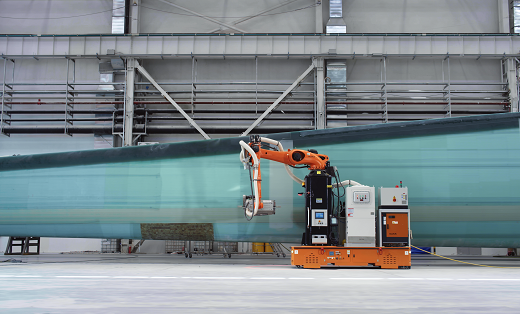
Breakthroughs have been made in the challenges of customization and high precision, and new progress has been made in the intelligent production of high-end equipment
2025.03.24




0 comments